

AI is Popping the Product Management Bubble
How AI will force product teams to shrink and why that’s a good thing for PMs

👋 Hello Technocrats!
I hope you’re enjoying the summer (at least here in the Northern Hemisphere).
Our AI-overlords still want us to accelerate adoption, so the other day I started wondering, ‘what’s going to happen to Product Management in the next couple of years?’
Cheers & let’s dive in! 🦈
Bobby
I’ve spent most of my career in executive meetings.
Whether its Board calls, annual planning sessions, budget reviews or offsites I’ve been a keen observer of how investors & executives think about how a good company should function.
And after quite a while of observing I started noticing some patterns.
One pattern I’ve seen repeatedly over the last 15 years is that although Product Management has grown significantly as a discipline globally, almost nobody in the highest executive ranks seems completely happy with the function of PM in their company.
That may sound strange because Product Management has never been more established as a profession overall. There are Product conferences, Product certifications, Product coaches, Product frameworks, Product influencers, Product podcasts, Product books, and entire consulting practices dedicated to helping organizations “do Product better.”
Yet despite all of that, most executives still aren’t entirely sure what they’re getting from their Product Managemnt organizations. Even after 15+ years many stakeholders continue to feel that since Product Management neither builds the product, nor sells it, the value they bring to the table is unclear at best.
While this can be true on the ground in some organizations, at good companies of course that’s not true at all — product management plays a vital role in both building and selling the solution / platform.
Nevertheless:
CEOs wonder why product roadmaps take so long and don’t turn into new revenue frequently enough despite heavy investment in discovery & market analysis.
CFOs struggle to understand the ROI on increasingly expensive product management teams that have a difficult time communicating their work in financial terms.
CROs who look desperately for new features so they can call prospects are constantly buffeted by late deliveries, buggy features and complaining customers.
While stakeholders are perpetually frustrated with PM, Product Managers are equally frustrated with the rest of the business & their view of Product Management. PMs argue that leadership doesn’t understand “real” product management, that it relegates them to project work, and refuses to give the function the money or influence it deserves.
The result is a peculiar situation where neither side appears particularly happy with the Product Management department. Yet companies continue investing in Product Management because that’s what you’re “supposed to do.” And product management leaders keep plugging away while continuing to insist that companies simply don’t “get Product.”
After 15+ years it’s worth considering that both sides may be looking at the product management function incorrectly.
I think people sense something is off, but rarely will they admit it.
PMs will never come forward in a company meeting and say that their function may not be creating much value because their careers are built on it. And business stakeholders won’t admit that they’ve been spending money unnecessarily on PM teams. Plus business stakeholders can’t pinpoint what PM is good for, but they often feel not having a PM might cause a problem too.
In short, nobody wants to be the person who asks whether the emperor has any clothes on. So everyone continues participating in the same broken mindset year after year, hoping the next framework, operating model, or reorganization will finally solve the problem of whether product management generates enough value for the company.
AI, by virtue of it automating a lot of product management “administrative” tasks will finally fix this problem.
15 Years of Trying Hasn’t Worked
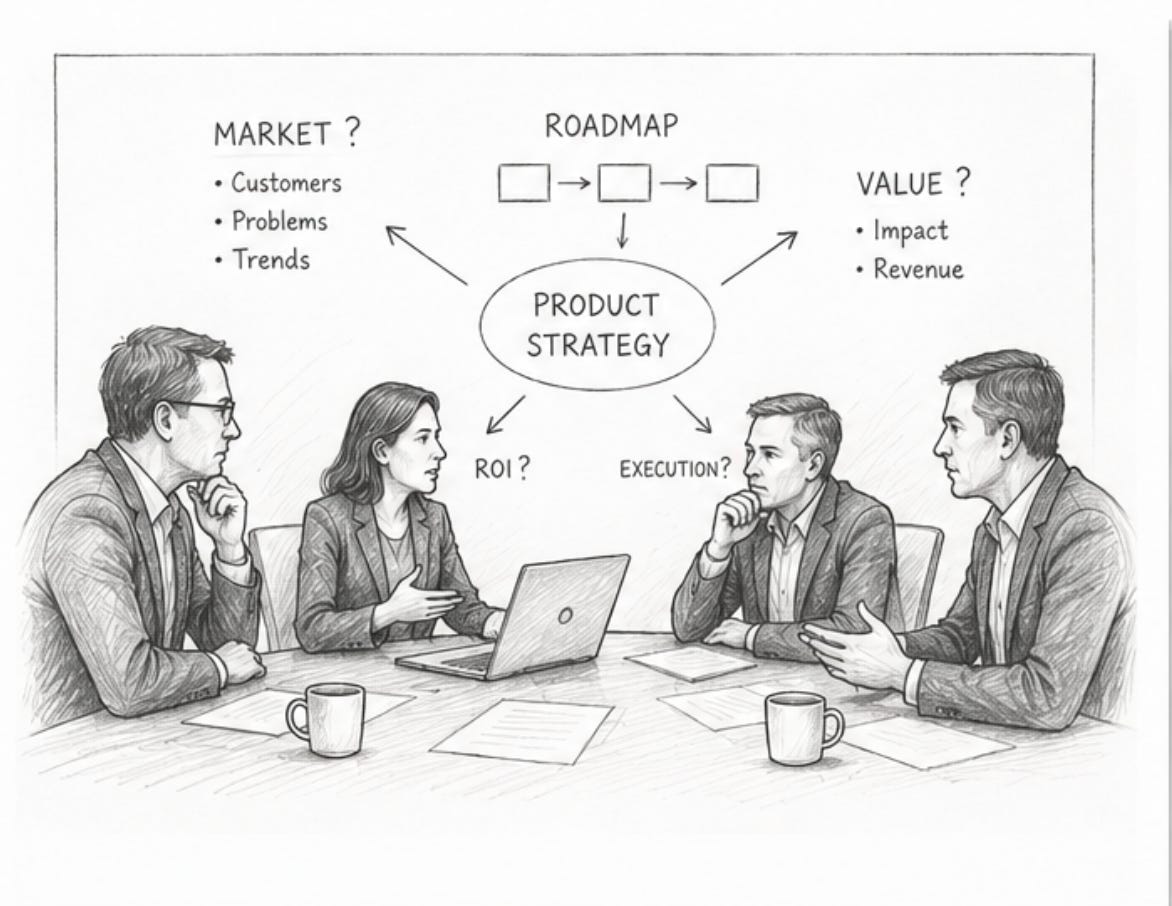
Product Management took off about 15 years ago in the early 2010s with companies investing tremendous amount into PM teams & entire PM organizations.
And yet in the ensuing decade & a half the PM community has failed to convince business stakeholders (who sign the checks) of the specific value of their function. This is a staggering failure if you think about it.
No other function has this issue: not Sales or Engineering or HR or Finance. Finance doesn’t spend every budget cycle explaining why it exists. Sales doesn’t continuously campaign for recognition. Engineering doesn’t have to remind executives that software needs to be built. The problem of showing value is unique to PM.
Product Management remains trapped in a perpetual conversation about its own right to exist and that should tell us something.
Why has Product Management struggled so much?
What We Get Wrong About Product Management
I think the industry has spent years operating under an assumption that very few people have bothered to challenge:
We’ve collectively decided that every software company needs a permanent Product Management department. The logic appears sound on the surface. Software companies build products, Product Managers help determine what products should be built, and therefore Product Managers should exist as a permanent fixture within the organization.
The problem is that this reasoning confuses importance with frequency.
Not every business capability is needed at the same intensity all the time. For example, think of Salesforce Implementation Specialists. They are brought in when you’re setting up Salesforce for the first time and they leave after the job is done.
I would posit that Product Management belongs in the same category for most (not all) mid-market organizations.
Here is when companies ACTUALLY need Product Management:
You’re in a startup inventing a new product
You’re doing a business pivot
You’ve lost your mojo and need to kick-start product again
You’re merging two products together (bolt-on)
You’re selling off a product line (divesting)
All of these events rarely take place in most companies and therefore most organizations don’t need product management continuously.
When companies do need product, AI can essentially handle a lot of what we consider product management tasks today, so team size also drops.
Identity Crisis
Product Management also suffers from an identity problem that makes life even more difficult for PMs.
Ask 10 executives what Product Management actually does and you’ll likely receive ten different answers. Some will describe Product as the voice of the customer. Others will emphasize strategy, prioritization, roadmap ownership, stakeholder alignment, innovation, user research, or requirements gathering.
Depending on the company, a Product Manager may function as a strategist, coordinator, analyst, project manager, or some combination of all four.
This ambiguity matters more than most people realize.
When a function lacks a clearly defined purpose, it becomes extraordinarily difficult to determine how much (i.e headcount) of the function an organization actually needs.
In countless executive discussions about Product organizations, the debate is rarely about the quality of individual Product Managers. Most PMs are smart, capable professionals. The real discussion is almost always about scale.
Leaders struggle to determine whether they need 3 Product Managers, 10 Product Managers, or an entire department at all.
What’s fascinating is that this debate continues despite the enormous amount of energy the industry has invested into Product Management over the last 15 years. At this point, if Product Management were going to solve Product Management, you’d think it would’ve happened already.
Yet here we are.
To be clear, this isn’t an argument against Product Management. I’ve worked with exceptional Product leaders throughout my career and some of the best strategic decisions I’ve ever seen came from strong Product thinking. This article isn’t about whether Product creates value. It absolutely does.
The question is whether organizations require that capability at the same intensity throughout their entire lifecycle.
Private Equity provides an interesting lens through which to view this problem. In PE, every function eventually gets asked the same question:
How much of this do we actually need?
Sales gets scrutinized. Engineering gets scrutinized. Finance gets scrutinized. Operations gets scrutinized.
Product Management is not exempt from that analysis.
The difference is that PM often struggles to answer the question because its value tends to be indirect and episodic rather than continuous.
AI may help resolve this ambiguity by forcing Product Management to become more specific about the work it actually performs.
AI breaks PM work into clearer pieces. Once the operational work becomes easier to automate, companies will ask the obvious question: what still requires a Product Manager?
The answer of course is judgment.
Great PMs understand customers, evaluate tradeoffs, connect product decisions to business outcomes, and help leadership decide where to invest. AI won’t make Product Management disappear, but it will make the difference between real Product work and “Product-shaped” activity much harder to ignore.
PM Creates the Most Value During Change
Peter Drucker famously observed that “the greatest danger in times of turbulence is not the turbulence—it is to act with yesterday’s logic.”
That’s a useful lens for understanding where Product Management creates the most value.
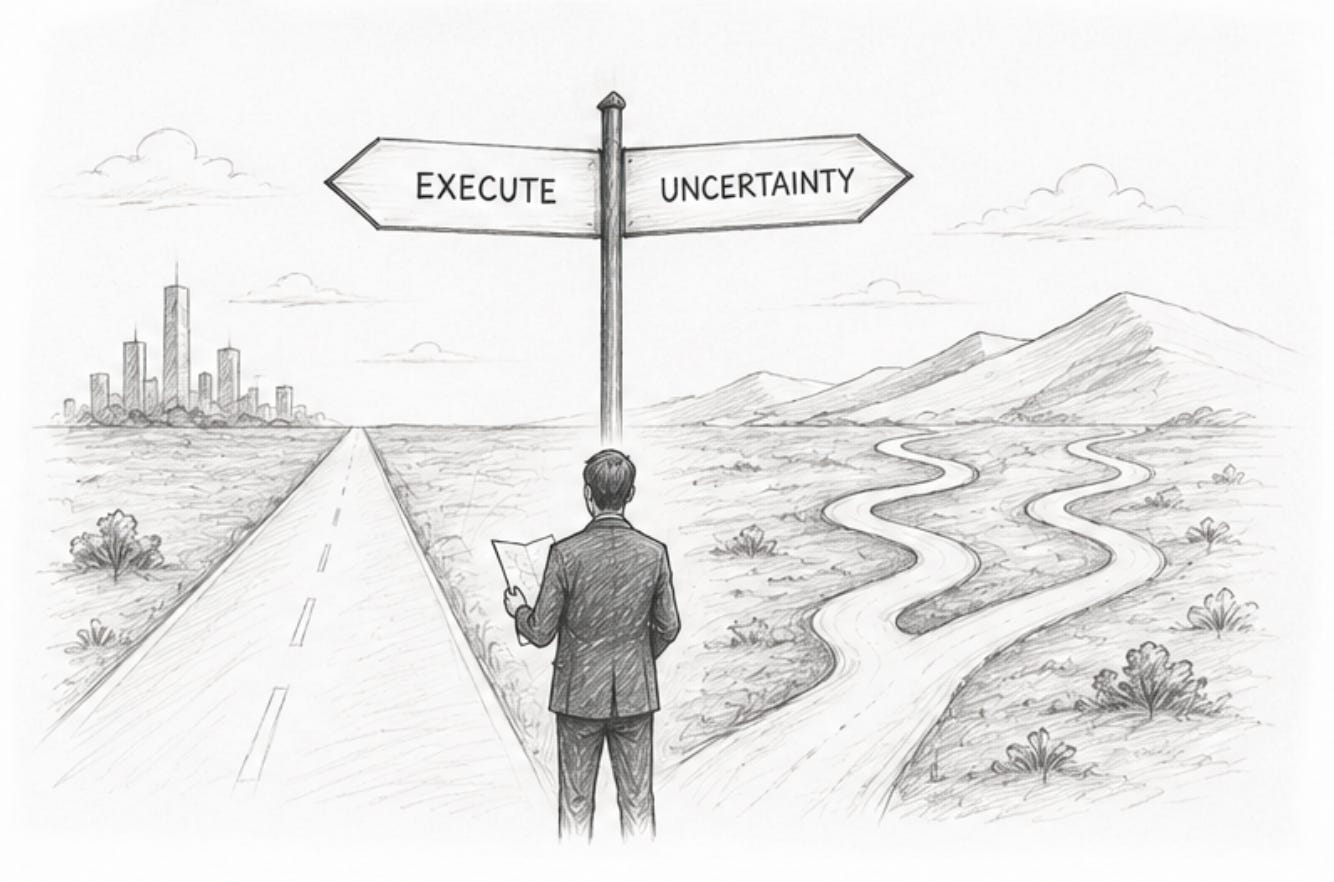
Contrary to what many organizations assume, Product is not primarily an execution function. It is a decision-making function. Its greatest contribution occurs when leadership is trying to determine what to do next, not when the organization is simply executing against decisions that have already been made.
If you’ve ever been part of a company that’s lost its way, you know exactly what this feels like. Revenue flattens and customer enthusiasm fades. The roadmap starts looking stale. Leadership begins asking uncomfortable questions about where growth is going to come from.
Those moments are stressful, but they’re also the moments where Product Management becomes incredibly valuable because the organization genuinely doesn’t know what to do next.
Throughout my career, I’ve worked with medium and large PE-backed companies. While these organizations differ dramatically in size and complexity, they share one common characteristic: periods of strategic uncertainty are relatively rare compared to periods of execution.
Critical Times PM is Needed
When a company is trying to discover product-market fit
When growth flattens out and leadership is searching for answers, strong Product leadership can change the trajectory of the business.
When an org is entering a new market, launching a major new offering, or considering a strategic pivot, PMs often provide some of the most important insights in the company.
These are moments when fundamental questions need answers. Which customers matter most? What problems are worth solving? Which investments create competitive advantage? What should be built next?
The value of Product Management during these periods is undeniable. The challenge is that most companies spend surprisingly little time in these situations.
Product leaders, and consultants often talk as though organizations are constantly reinventing themselves or their products, but most businesses spend the overwhelming majority of their lives executing.
They’re selling products, serving customers, scaling operations, hiring employees, improving margins, and delivering against strategies that have already been chosen.
Once a direction has been established, execution becomes far more important than discovery.
Yet many organizations continue staffing Product Management as though they are permanently searching for a new strategic direction.
This creates an interesting dynamic. When a function exists continuously but its highest-value work occurs intermittently, it naturally begins filling its time with lower-leverage activities.
More planning cycles emerge. More alignment meetings appear. More frameworks are introduced. More roadmap reviews occur. More documentation is generated.
None of this is necessarily bad. However, much of it exists because the organization has supplied more Product capacity than the business actually requires.
Every department expands to fill the space available to it and Product Management is no exception.
AI Changes Everything
Most discussions about AI and Product Management revolve around productivity improvements such as the following:
AI can write requirements
AI can summarize customer interviews
AI can perform research
AI can analyze customer feedback
AI can generate documentation
All of that is true, but productivity isn’t the real story. The real story is organizational.
For years, product management organizations justified their size because many activities required significant manual effort.
Customer research took weeks. Competitive analysis consumed valuable time. Documentation and requirements gathering required entire teams.
AI is rapidly reducing the amount of labor required to perform these activities.
That’s the part I think most people are underestimating in terms of how it will impact the typical product team.
For 15+ years we’ve treated the “administrative” work surrounding Product Management as evidence that large Product organizations are necessary. AI may reveal that much of that work was simply overhead we learned to accept.
As AI makes more impact, organizations will inevitably begin asking a more fundamental question:
If the operational workload decreases dramatically, how much Product Management do we actually need on a continuous basis?
The answer is unlikely to be 0. Strategic thinking remains valuable. Customer understanding remains valuable. Decision making remains valuable.
However, organizations may discover they need fewer people focused on operational Product work and more people focused on high-leverage strategic decisions at specific times.
In many ways, AI won’t destroy Product Management, it will reveal the proper structural model it should’ve been operating under for the last 15 years.
The Rise of Fractional PMs
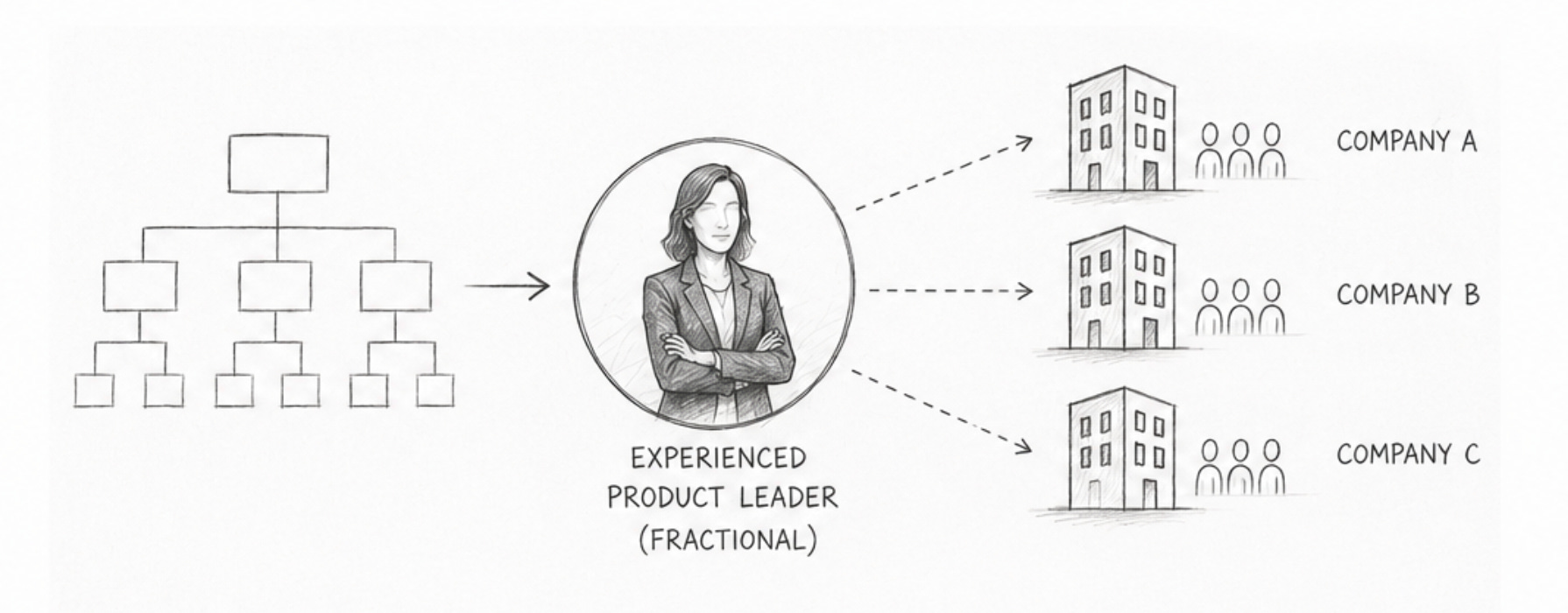
One of the more interesting signals that PM is shrinking because of AI and that the “shrinkage” is already underway can be found on LinkedIn.
Over the last few years, I’ve noticed a growing number of experienced Product leaders repositioning themselves as fractional CPOs, fractional Heads of Product, and Product advisors.
These titles were relatively uncommon not long ago but today they’re everywhere. Of course, market transitions rarely announce themselves formally. More often, practitioners recognize changing demand before the broader industry does.
The rise of fractional PM leadership suggests many experienced PMs have already concluded that organizations want access to product expertise without necessarily wanting a permanent department with a large expense base.
Imagine a software company 10 years from now. Instead of employing an entire Product department, it has just 1 highly experienced Product leader supported by AI systems & agents that perform most of the operational work. The company brings in additional Product expertise during major strategic events—a market expansion, a stalled growth period, an acquisition, or a significant pivot.
When viewed through this lens, the trend makes perfect sense. Most companies don’t need a large Product organization indefinitely. What they need is access to exceptional Product expertise during critical moments in their lifecycle.
Conclusion
I don’t believe Product Management is going away. But I believe the Product Management bubble is about to pop.
Over the last 15 years we’ve built an entire ecosystem around Product Management—departments, career ladders, certifications, conferences, consultants, operating models, and an ever-growing collection of frameworks designed to help companies “do Product better.”
Somewhere along the way we stopped asking a very simple question: How much Product Management does a company actually need?
For many organizations, I suspect the honest answer is “less than we have today.”
That’s not because Product Management lacks value. Quite the opposite. Great Product Managers create enormous value when a company is trying to determine what to build, where to invest, and why customers aren’t responding. Those are difficult, high-leverage decisions that can fundamentally change the trajectory of a business.
The problem is that most companies don’t spend the majority of their lives making those decisions. They spend most of their lives executing.
That’s the distinction the industry has missed.
We’ve confused the value of Product Management with the amount of Product Management required.
Every bubble begins with something real. The internet was real. Cloud computing was real. AI is real. Product Management is real too. The mistake isn’t believing in the underlying idea of these things, it’s assuming that because something is valuable, you need ever-increasing amounts of it.
AI is already testing that assumption in a very serious way.
As more of the administrative and operational work surrounding Product Management becomes automated, companies will naturally begin questioning the size, shape, and purpose of their Product organizations.
Some businesses will continue to need large Product teams because of the complexity of what they build. Smaller orgs that operate like startups still finding their product-market fit will also need Product help. But many orgs just will not.
When the bubble pops, the profession won’t disappear. It will simply return to the size it always should’ve been.
Ironically, that may be the best thing that’s ever happened to PMs because now their work will be more clearly valued.