

AI Won’t Make Your Company More Productive
6 Reasons Your AI Investments May Never Show Up as Productivity

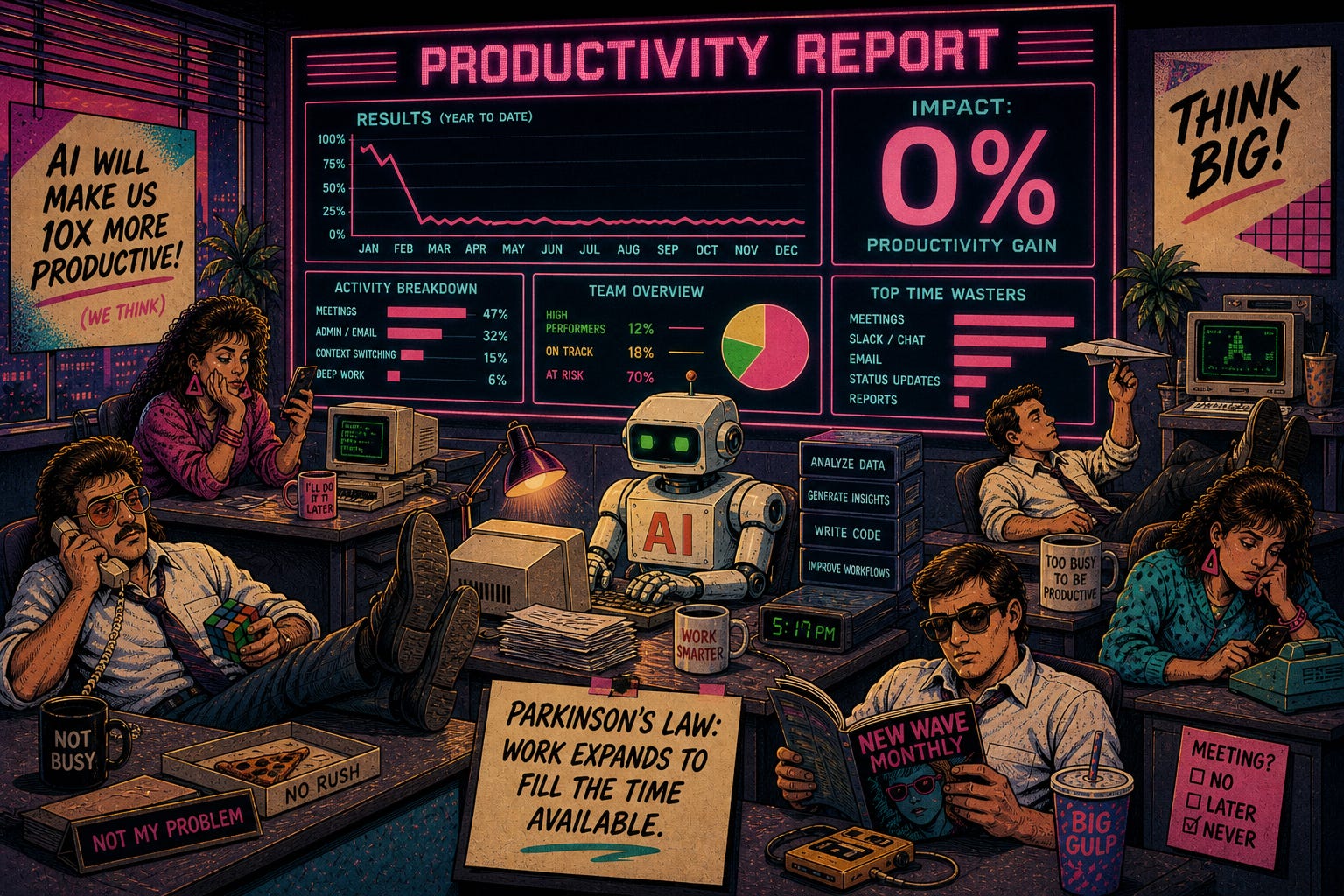
I’m going to say something most people in tech won’t.
The AI productivity revolution isn’t coming.
Not in 2026. Not in 2027. Not in five years. Possibly not ever — at least not for the company you work at right now.
I know how that sounds.
Every CEO is promising 30% productivity gains. Every consultant has a deck. Every vendor has an AI demo. And every Board is being told the transformation is “well underway.”
It’s not.
What’s actually happening is something much darker, and almost nobody is ready for it.
Here’s what nobody is talking about: there are significant opposing forces inside every modern enterprise actively destroying AI productivity gains.
These forces are not technical. And they’re not fixable with a better AI model. They’re cultural, structural, and human — and they’re already winning against AI.
Most leaders don’t see them yet. By the time they do, it’ll be too late to explain why the productivity numbers never materialized.
Let’s pull back the curtain on these hidden forces. 👇
Americans Don’t Like Measuring Productivity
The U.S. for the most part has a very different corporate culture when it comes to tracking productivity compared to Europe, China and Japan.
Typically in the U.S. the only time you’re measuring productivity is if you’re working in manufacturing or a similar industry.
Sure, customer support teams in look at things like ticket-related KPIs, but for the most part if the customers are happy, American companies are happy.
In fact, There was a wave of consultants in the 80s who tried to sell productivity services and they were summarily rejected by most U.S. industries & they haven’t shown up again since.
Now, AI is forcing every c-suite executive to measure productivity, but we just don’t have the culture for it. Japan does. China does. Europe probably to a degree. But not the U.S.
By the way, guess which department is taking the brunt of productivity measurement currently? Yes, you guessed it — Engineering (and Product).
Software engineering is the “manufacturing” of the modern enterprise so it makes sense. And I think we’re handling the AI-driven productivity situation admirably so far.
But outside of Engineering there’s just not much of an appetite to look at productivity. American corporate culture isn’t wired that way.
Did you get the sale? Then that’s all that matters. It makes no difference to anyone that you made 50 calls to get it instead of 2.
Oh, sure every Sales Ops person will say it matters, but lets be honest — they don’t matter at the highest-level as long as the revenue is coming in.
And that’s just one example.
Fear of Job Loss De-incentivizes Productivity Tracking
Do you think people want hardcore measurement of their own productivity in any company? Not in the slightest. That’s the last thing they want to do — they’re scared.
And to be fair, they’re not wrong to feel that way.
The moment productivity becomes measurable, it becomes comparable. And once it’s comparable, it becomes a way to get exited really fast.
What do you think is happening at the big tech companies? Organizations like META are going down this route already and putting systems in place to track EVERY KEY STROKE!
These companies are looking at:
Who’s producing the most
Who’s lagging behind
Which teams are overstaffed
Which roles don’t need to exist
Ambiguity is much safer for most companies & teams. As a result there’s no burning desire to go deep into productivity numbers.
So even when companies say they want AI-driven productivity, the behavior underneath tells a different story. They’ll pilot tools. They’ll run experiments. They’ll talk about transformation.
But they stop short of the one thing that actually matters to growth: measuring productivity in a way that could force real change & potential job loss.
Productivity is Often a Silly Metric
The biggest thing leaders forget is that not all productivity is created equal.
Do you honestly think that making your dev team 2x more productive is going to do anything for your company?
Doubtful & here’s why:
Because Product probably chose the wrong thing to build
Because the market isn’t ready for the next big feature you’re working on
Because the sales team stinks and can’t sell it anyway
Because the company is about to be sold
And because your customers just want their old bugs fixed, not new features
So what did all your engineering velocity do for you?
In the grand scheme of things it probably just made people in Engineering happier that they’re going faster & have more knowledgable about AI. And maybe they also got a pat on the back from the CTO.
But that’s about it.
Not every kind of productivity is useful to businesses. Only very specific kinds of productivity turns out to be helpful to a companies growth and success.
Until organizations figure out which productivity specifically is important for their business & context then no amount of general improved productivity from AI will positively impact business metrics.
Properly Measuring Productivity is Expensive
If you go to any typical $100M revenue company with say, 350 to 500 people, and you have to measure AI-driven productivity, that will cost at least several percentages of your budget when all is said and done.
Sure, the CEO can give the responsibility to their functional leaders, but they won’t do the work. Functional leaders have no time to measure productivity! They are busy making sales, building software or handling HR — measuring productivity is SUPER LOW on their priority list.
That means a CEO has to form a task-force just to go around measuring productivity and that’s going to cost companies in payroll, tools & time.
Also every department will fear & hate that task-force…
So most medium / large companies are living a delusional fantasy that they’ll properly measure productivity. What will actually happen is that they’ll see the true cost of it & just give up.
And there’s already evidence of this.
I know 2 multi-billion dollar companies that have given up tracking productivity. No department wanted to do the work. And when they formed a task force, that team got absolutely 0 cooperation from their peers.
Companies should be wary of how much just MEASURING productivity COSTS! 🫰
AI Productivity is Killed by Parkinson’s Law
When an engineer saves 90 minutes using Claude, those 90 minutes don’t turn into 90 more minutes of shipped code.
They evaporate. Into Slack. Into a longer lunch. Into “thinking time.” Into one more meeting that didn’t need to exist.
This is Parkinson’s Law colliding with AI adoption in white-collar jobs.
Work expands to fill the time available, and knowledge work is squishy enough that there’s no forcing function to capture the savings.
A factory floor converts 90 saved minutes into more units shipped. However, a marketing manager converts 90 saved minutes into…vibes? Or maybe a Peloton ride at lunch. 🚴
This is one of the biggest hidden reasons productivity gains aren’t showing up in reports.
The savings are real at the individual task level — they just never aggregate into anything a c-suite leader can point to.
Until companies redesign roles around the new throughput (which they won’t, because of all the reasons discussed), the time savings will keep slipping through the cracks
Too Many People Don’t Believe in AI
This is potentially the biggest reason AI-driven productivity isn’t happening now and possibly will NEVER happen the way we imagine.
The two most important things in life might be love & money. And blockchain was supposed to revolutionize the latter, but never did.
Oh, the hype for it was unreal back in about 2017. I talked to so many CTOs and technology leaders back then who were excited beyond belief about the potential of blockchain.
And yet, at the end of the day, nothing of consequence came out of it for most enterprise organizations.
I believe a huge % of the corporate workforce views AI in a very skeptical fashion because of what happened with blockchain and other transformations like Agile, which largely failed to deliver results.
In fact, I think at least 50% of any companies headcount are just going along with the AI hype for fear of being ostracized — they don’t really believe in it.
If you also layer on fears that AI willl bring some kind of Terminator-like calamity into the world, then these people aren’t going to play ball the way Boards & investors want when it comes to driving productivity.
In fact, I believe the more AI gets better technologically, the more these individuals will view AI as smoke & mirrors and secretly try to resist it.
Conclusion
So what’s actually going to happen?
Well, AI is not going to organically drive increased productivity, that’s for sure. Not in 2026. Not in 2027. Not ever — unless something fundamental changes.
Because every force inside the modern enterprise is pushing in the opposite direction:
There is no productivity culture in American companies
Fear of job-loss deincentives productivity tracking
Productivity is often not even the right metric to look at for companies
Measuring productivity costs an arm & a leg
AI-driven productivity in white collar jobs is destroyed by Parkinsons Law
Most importantly at least 50% of people don’t even believe in AI
So what do you get? AI is everywhere but productivity benefits are nowhere.
That’s exactly where things stand right now.
This is why the future belongs to AI-native companies that started in the last few years. These companies haven’t known a world WITHOUT AI.
Everything they do is AI-first. So, these companies won’t need to efficientize themselves. They won’t know anything BUT speed.
Instead, these companies will efficientize entire MARKETS.
But that’s a story for next week. 🙂
In the meantime, stay frosty & keep the shark swimming. 🦈