

The Truth About Enterprise AI in 2026: What C-Suite Leaders Need to Know
Where AI has created real value, where it's consistently fallen short, and what executives should internalize as expectations and costs continue to rise.


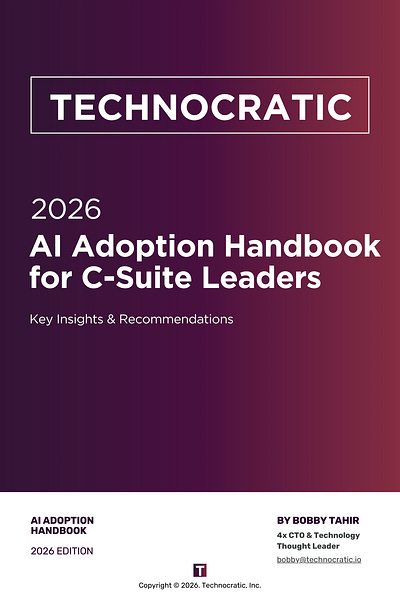
2026 AI Adoption Handbook for C-Suite Leaders: Firsthand Insights from the Field
To help C-Suite execs execute AI Adoption more effectively in 2026, I compiled firsthand observations and recommendations derived over the past year working with companies to improve AI outcomes.
Download the 2026 AI Adoption Handbook for C-Suite Leaders—it’s available and free for Technocratic subscribers exclusively:
While the handbook contains an in-depth analysis, detailed recommendations, and reflections from conversations with CEOs, CTOs, and CFOs, this article will be slightly higher-level, touching on the key takeaways from the last year.
2025 was supposed to be the year AI transformed business operations...
Instead, it became the year of climbing costs, skill shortages, and unfulfilled promises.
I work with companies across industries on AI adoption. Many of the organizations I helped struggled significantly with successfully implementing AI at the Enterprise level. I spent the last year unpacking why that was the case—so I could understand how to fix it.
(5) critical realities every C-Suite Leader needs to know:
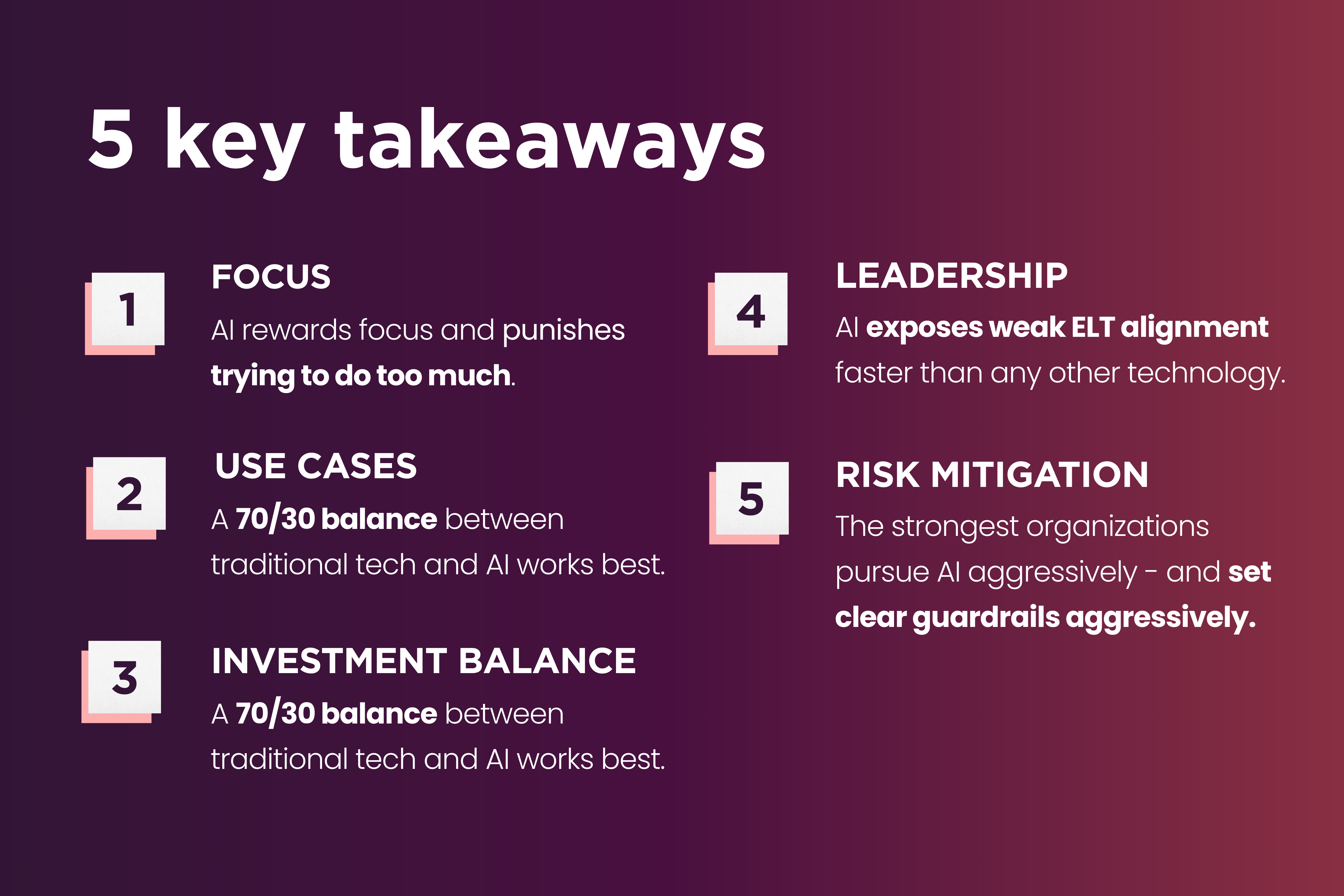
There’s a clear pattern emerging here: AI is creating real but limited value in select areas, while costing more and taking longer than expected. The gap between AI hype and AI reality is the defining challenge of 2026.
The companies that will win are not those investing the most or moving the fastest. They’re the ones treating AI as a disciplined operational capability with clear guardrails, not a revolutionary silver bullet.
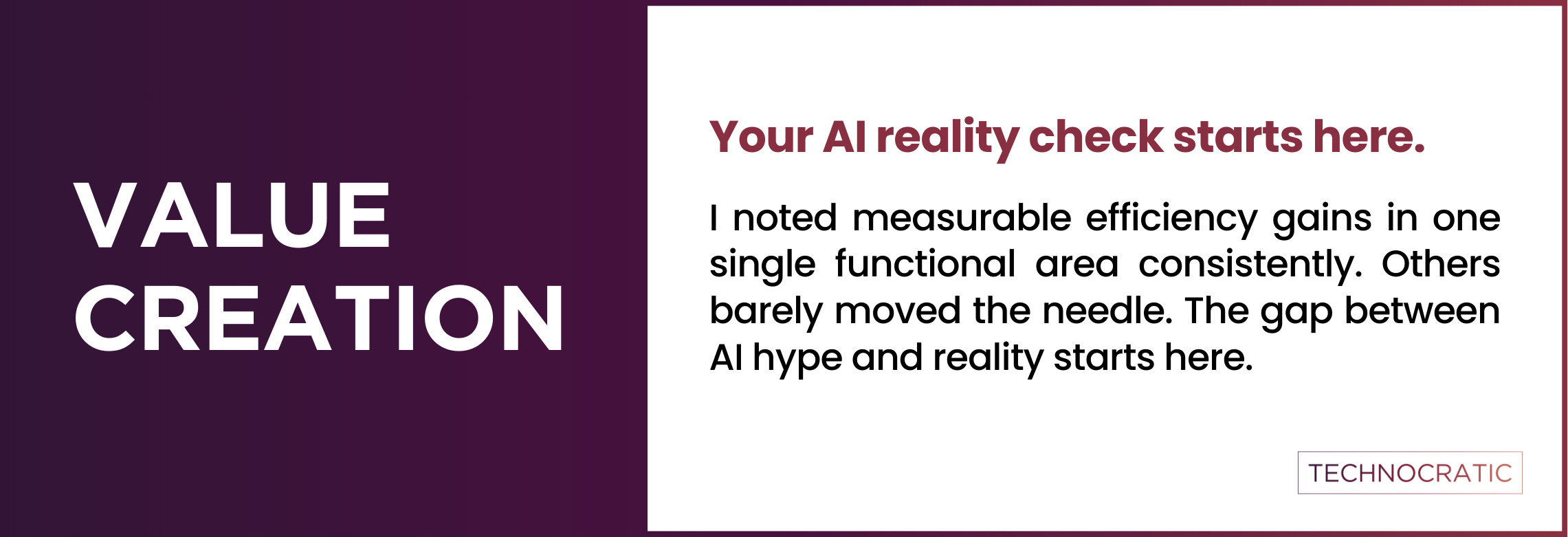
The Winner: Customer Support
I saw Customer Support benefit the most from AI in 2025, with efficiency improvements as high as 50% in some cases. Other departments saw only 15-20%
It’s worth noting: projects that saw the best results often did require third-party vendors, significant configuration, extensive change management. I found it took an average of 6-8 months before productivity appeared.
Product Roadmaps: The 10-20% Reality
Average SaaS companies attempted 3-7 major new AI product capabilities. Only 10-20% got real customer traction. Why? Product teams chose wrong use cases, Sales/Marketing couldn’t sell AI features effectively, and Engineering delays.
The somewhat confusing reality: customers demand AI features whether they offer value or not. In 2026, companies should remember: AI shouldn’t be on your roadmap to create hype. Use usage data and defensible proof to decide where AI actually makes the product better. Start there.
The Uncertainty Tax
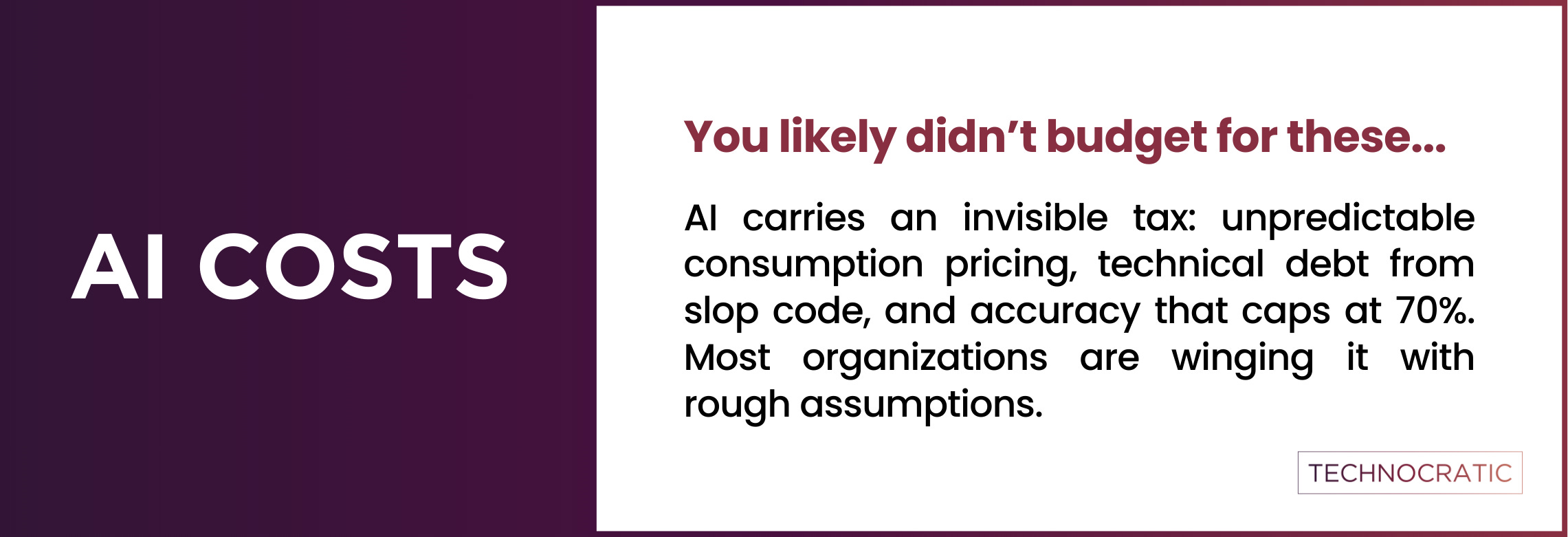
Every company deploying AI pays an invisible tax. Unlike Cloud, AI spend is unpredictable: consumption-based pricing makes budgets volatile, model costs change constantly, and there’s no mature discipline for forecasting. Most organizations I’ve observed are genuinely winging it.
Efficiency Gains & Technical Debt: The Unavoidable Tradeoff
If something seems too good to be true, it usually is. AI coding tools deliver 15-20% velocity improvements—then teams spend that time (and more) cleaning up slop code.
This technical debt requires your senior engineers to retroactively fix AI output instead of moving your product forward. AI can’t comprehend complex legacy systems, and accuracy caps at 70% in most cases (40% in many). Getting to 90%+ requires very hard work, and inaccuracy creates costly rework at the “final mile.”
Agents: Still Unproven
I haven’t seen AI Agents work well in most companies. The few that deployed them paid much more than anticipated with questionable ROI. 2025 was not the year of Agents—as we move through the early days of 2026, I consider Agents to still be a largely unproven paradigm.
AI Exposes Weak Leadership
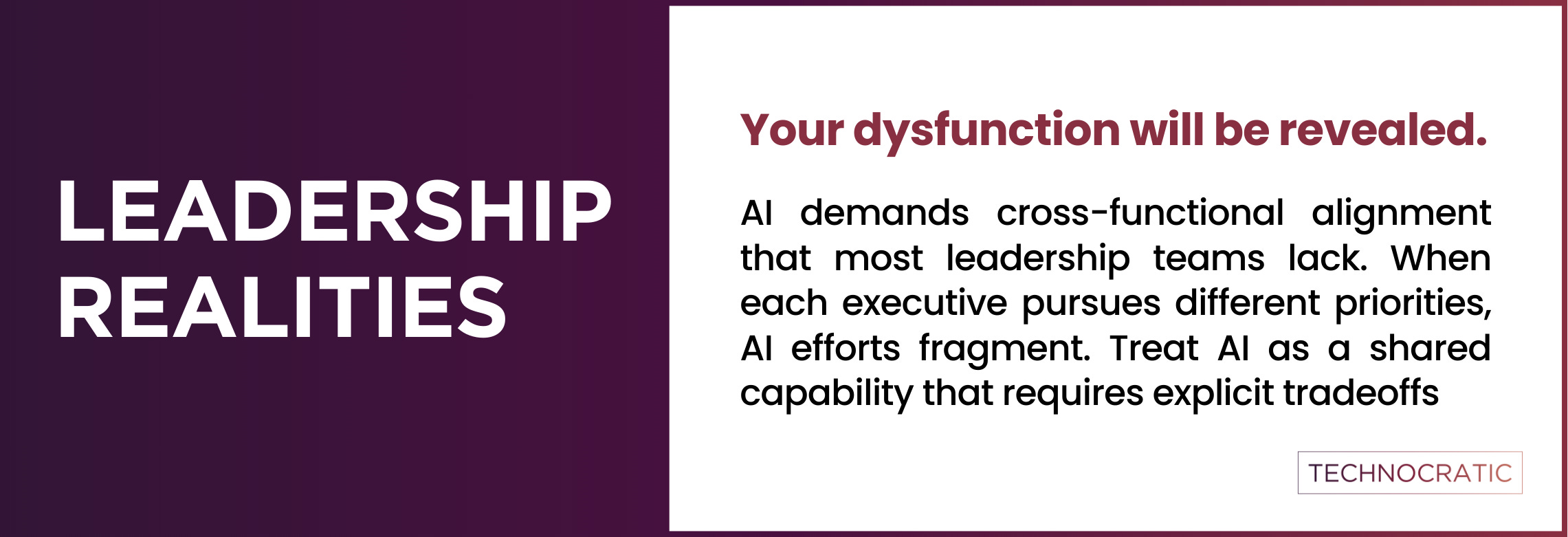
AI success depends on Executive Leadership Team alignment. Top-down initiatives consistently outperform bottom-up experiments in the organizations I work with.
The problem I see most often: each executive views AI through their functional lens—Sales wants deals, Product wants features, Finance wants cost reduction. This creates fragmented efforts and diluted outcomes.
When it comes to AI Adoption at the Enterprise level, there’s a harsh truth that bears noting: AI exposes weak ELT alignment faster than any other technology I’ve seen in my lifetime. Where the ELT is cohesive, AI accelerates results. Where it isn’t, AI significantly amplifies dysfunction.
The CAIO Experiment: Mostly Failed…For Now
Hiring a Chief AI Officer became one of 2025’s trendiest moves. That said, I did not see it substantially improve AI adoption success in most cases. Creating single-threaded ownership doesn’t work for broadly applicable technology.
My take: Most CAIO initiatives I observed lasted only 6-9 months.
Exception: CAIOs can work with a very specific mandate—like launching an AI product.
Board Pressure Continues
Boards remain optimistic about AI despite unfulfilled 2024-2025 promises. Managing upwards regarding AI has become a necessary C-suite skill in a way Cloud never demanded.
Doing More With Fewer People
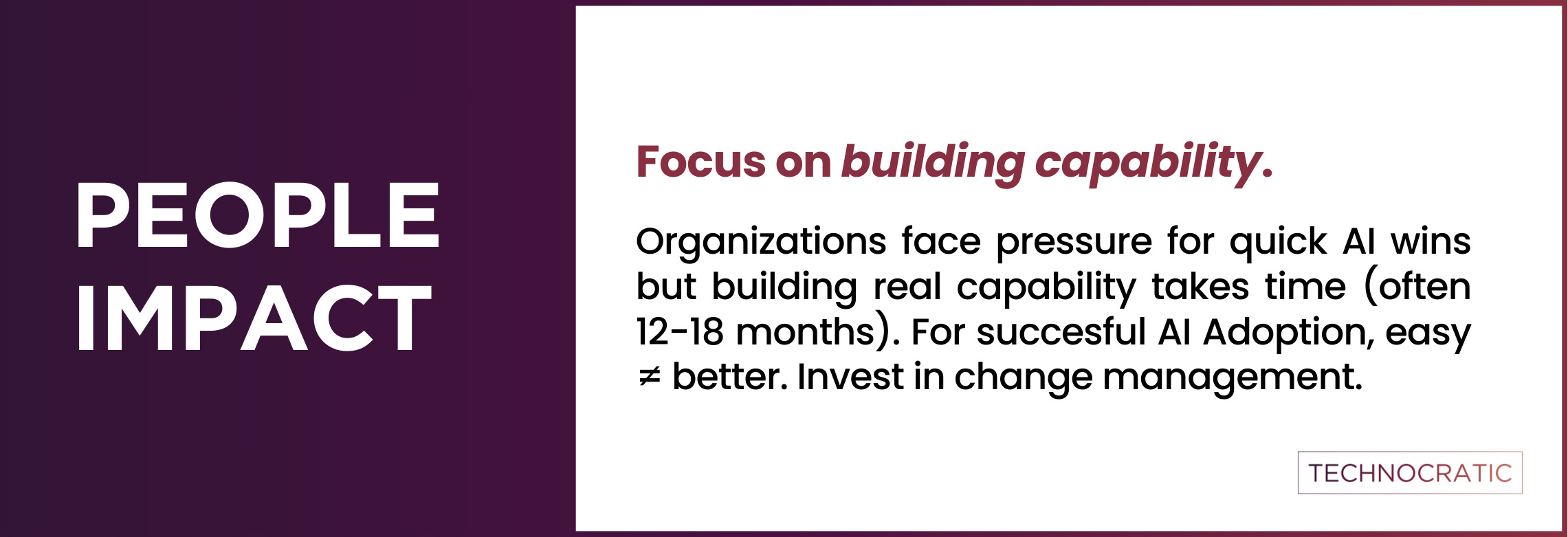
The attractiveness of “AI-native” teams is significant among Boards. CEOs must navigate the impact of the belief that AI can significantly reduce headcount. Surprisingly, pushback from employees in 2025 was less severe than I expected—perhaps due to the news cycle of big tech layoffs.
Think Twice Before Hiring AI Consultants
True AI technical experts still only exist in tiny pockets. Most are more research-oriented than commercially-minded. Building complicated AI systems takes a Senior Engineer at least 2 years to master.
For most enterprise use cases, you’re better off leveraging third-party vendors and training internal teams. If you find a rare expert Senior AI Engineer ($300-500K in big metros), snap them up—they can accelerate projects by 3-5x.
Change Management: Underinvested
Organizations routinely underinvest in Change Management, yet it’s critical for permanent AI adoption. Teams have a strong tendency to revert to old habits. It takes ELTs 6-9 months to identify winning use cases—many never get it right.
AI Vendors: Separating Signal From Hype
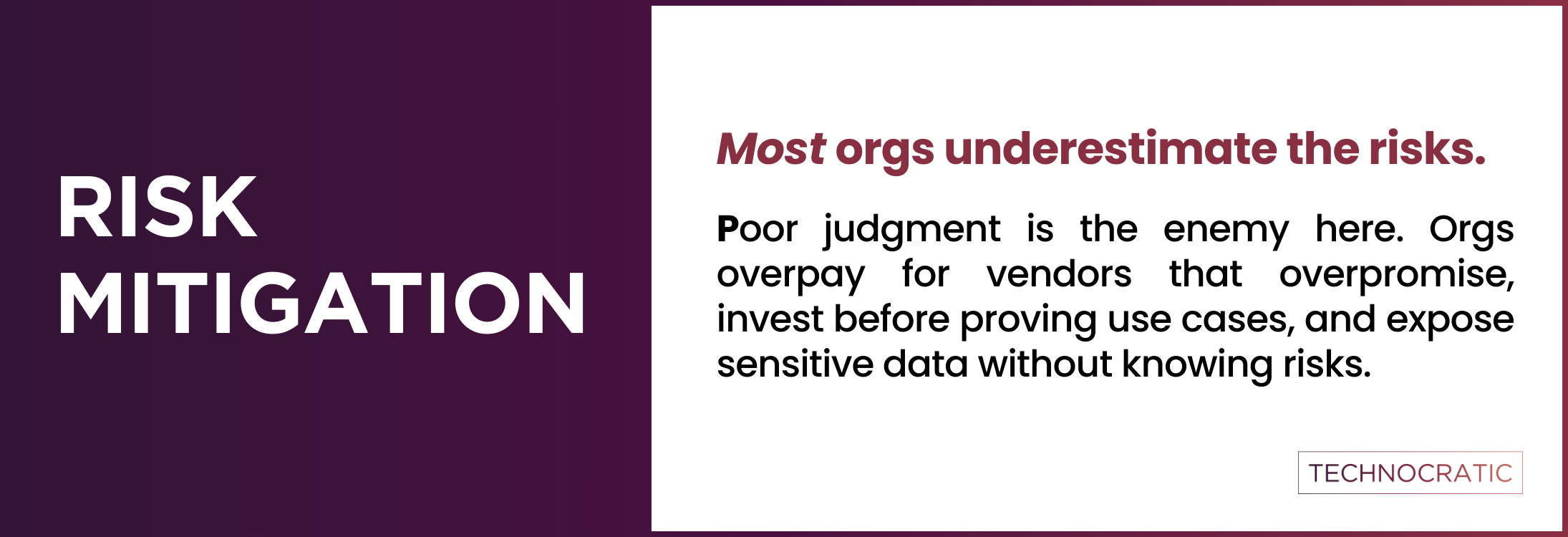
I’ve looked at dozens of AI vendors over the last two years. Most are still “more hype than substance”—sometimes by a large margin. Demos are slick, but real-world results are underwhelming.
Before committing $300K annually, make vendors prove their solution works inside your company, on your data, within your constraints. If it sounds too good to be true in AI—it is.
Don’t Boil the Data Ocean
Experts claim you need expensive upfront data cleanup. Reality: it depends on your AI use cases. Data readiness should follow proven AI use cases, not precede them. Most companies need very good data in specific places, not perfectly cleaned enterprise-wide data.
Spending millions upfront to “get the data right” without clear ROI is wasteful.
The 2026 Security Breach: It’s Coming
I’ve found most companies significantly underestimate AI security risks. Organizations pipe sensitive data into AI systems without understanding where it goes or how long it’s retained.
Prompt leakage, model misuse, and shadow AI usage is already common. Security teams apply old frameworks to a fundamentally new attack surface.
I believe there will almost certainly be a major AI-related security breach in 2026. Smart organizations are hiring CISOs trained in AI security—even fractional CISOs are better than none.
AI’s Impact on Exits
If you’re selling your business, I’ve seen buyers want to see serious AI value generation. Be prepared to show smart AI investment on its way to generating value, even if not yet fully realized.
With buyers, it’s easier to show Product-level AI outcomes than enterprise-wide efficiency gains. Buyers are skeptical of internal efficiency claims unless there’s clear, defensible evidence—like hitting the same sales targets with half the sales team.
When the AI Market Pops
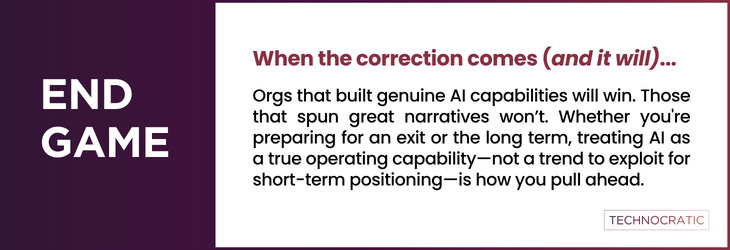
An AI market correction is inevitable—mirroring the dot-com bubble collapse. Companies not generating value will disappear. If it happens in 2026, it will impact acquisitions, exits, and talent markets dramatically.
But it will also quiet Boards temporarily, make hiring AI talent easier, eliminate hype-driven vendors, and force businesses to be clear about ROI.
The winners will be leaders who treated AI as a true operating capability, rather than just a narrative to be sold.
The Bottom Line:
The defining tension of enterprise AI in 2026 isn’t between adoption and resistance—it’s between hype and reality.
From my work with dozens of organizations, one thing has become clear: AI creates measurable value in specific applications but requires more investment, takes longer, and demands stronger leadership than most organizations anticipated.
The gap between theory and reality comes down to five factors: discipline in focus, precision in use-case selection (6-9 months), balance in investment (70/30 traditional/AI), strength in leadership (top-down, ELT-aligned), and rigor in risk management.
My recommendations for C-suite leaders in 2026:
Customer Support is your proving ground — start here. It is hands down where I’ve seen AI consistently deliver the most.
Expect 6-8 months before productivity shows up, even in successful implementations.
Hold vendors accountable. Most are still more hype than substance.
Drive adoption from the top. Bottom-up experimentation rarely works.
Prepare for a market correction. Disciplined operators will be positioned to win.
The organizations that succeed won’t be those that moved fastest or invested the most. They’ll be those that chose the right battles, maintained realistic expectations, and had leadership teams capable of driving lasting change within clear boundaries.
The age of AI experimentation is over. The age of AI accountability has begun.
If you want the full scoop, download the handbook.
You’ll find clear recommendations tied to every observation, plus insights that reflect real conversations I’ve had with C-Suite leaders—those who have been successful in AI Adoption and those who have not.
The purpose of sharing this is to offer helpful guidance—I hope that’s what you find.
Thanks for being here!
Want to discuss your organization’s AI strategy? I work with CEOs, CTOs, and Boards to help navigate major technology transitions. Reach me at bobby@technocratic.io or visit technocratic.io
"The winners will be leaders who treated AI as a true operating capability, rather than just a narrative to be sold."
Profound.
Bobby, A Very detailed breakdown on how to consider AI as a power tool in the enterprise..
WALK, CRAWL, RUN should be the motto.
instead of doing too many things too fast, start with focus on what can yeild results which can later scale. Like any enterprise project, no point in rushing with implementation, but be clear on what we expect the outcomes to be, how will they tie to long term strategic results rather than just AI sprawl.
In parallel look at spreading Ai literacy which can help flesh out use cases. These use cases are fast followers for the initial AI success so we gain momentum.
Technocrats are taking over right now, and everything is going as plan. Read THE TECHNATE to learn more about the plot taking place to topple the American Emprie.
https://www.amazon.com/TECHNATE-Chamir-Ledesma/dp/B0H6H8B4YC/ref=tmm_pap_swatch_0