



What is Weekly Zeitgeister?
Weekly Zeitgeister is a new series powered by Zeitgeister, a tool I built to track what’s actually moving in tech, rank top stories, and turn them into usable insight. Each week, I pull one high-signal headline per day from Zeitgeister, attach a brief summary, and then share why it matters if you’re building or running software at scale.
This Week at a Glance
Monday’s Headline: 2025: The Year LLMs Became Indispensable in Workflows and Integration
Tuesday’s Headline: Windows 11’s Downward Spiral: Linux Gains Ground as Users Seek Stability and Control
Wednesday’s Headline: BYD Overtakes Tesla: The New King of Electric Vehicles
Thursday’s Headline: DeepSeek’s mHC: Revolutionizing Deep Learning with Manifold-Constrained Hyper-Connections
Friday’s Headline: Local-First AI: A Growing Trend for Privacy-Conscious Developers and Professionals
Monday – 2025: The Year LLMs Became Indispensable in Workflows and Integration
Sentiment Analysis: 55% Positive | 15% Negative | 30% Neutral
What happened
2025 is being framed as the moment LLMs crossed from novelty to production infrastructure, with organizations moving from isolated pilots to embedding models directly into core workflows.
The center of gravity has shifted from “should we use AI?” to architecture decisions: how to blend deterministic code with LLM components (copilots, RAG, agents) in ways that are scalable and maintainable.
Real-world implementation friction is now the dominant conversation—teams are fighting cost at scale, reliability guarantees under non-determinism, and debugging/maintaining systems where “the decision path” may be model-driven.
Why it matters
Architecture + cost structure risk: LLM integration changes unit economics (API spend, latency, infra) and pushes decisions into systems design—not tooling selection—so early patterns can lock in long-term cost.
Reliability + maintainability risk: Non-deterministic outputs create new failure modes (harder QA, harder debugging, drift) that can quietly degrade product reliability if not engineered for explicitly.
Competitive timing risk: As implementation patterns standardize, teams without a deliberate framework will either underinvest (fall behind) or over-integrate (ship expensive, brittle systems) while better-prepared competitors compound advantage.
Actionable Insights
Define a decision framework: Standardize when to use deterministic workflows vs LLM-driven components (what qualifies, what doesn’t) so architecture isn’t decided ad hoc team-by-team.
Instrument before you scale: Put measurement in place for cost, latency, and output quality (plus guardrails and evaluation) so adoption is driven by telemetry, not hype.
Operationalize “LLM readiness”: Create a recurring internal briefing + scenario planning cadence so leadership assumptions track the pace of capability change and your roadmap stays aligned.
Boardroom Talking Point
“2025 wasn’t ‘the year we tried AI’ — it was the year LLMs became production infrastructure. The prerogative now should be how we architect deterministic systems alongside LLM-driven components without creating unbounded cost, reliability risk, or an implementation gap versus competitors.”
Tuesday – Windows 11’s Downward Spiral: Linux Gains Ground as Users Seek Stability and Control
Sentiment Analysis: 25% Positive | 55% Negative | 20% Neutral
What happened
A credibility shift is underway: Technical users are increasingly vocal about Windows 11 stability issues, workflow-breaking bugs, and driver problems—pain points that historically pushed people toward Windows, not away from it.
“Setup overhead” is becoming a meme: New installs are being characterized as bloated, requiring IT time to disable ads, unwanted features, and aggressive upselling before machines are production-ready.
Linux is moving from theoretical to tactical: Sysadmins are actively sharing migration playbooks and success stories of fleet-scale moves, treating Linux desktop as a viable enterprise option—not just a developer preference.
Why it matters
Productivity tax: If IT and engineering spend meaningful hours “fixing the OS” (policies, updates, unwanted features, stability), that’s a compounding drag on output.
Control-plane risk: When users feel the OS is optimizing for the vendor’s priorities over user productivity, trust erodes—even in areas where Windows maintains technical advantages (like newer hardware compatibility)—and “Windows by default” stops being a neutral assumption.
Talent pressure: The more Linux is viewed as credible for daily work, the more rigid Windows-only policies can show up as retention/hiring friction.
Actionable Insights
Quantify the Windows 11 overhead: Track ticket volume, hands-on IT hours, and downtime attributed to Windows stability/updates/bloat (turn complaints into a cost line item).
Run a contained Linux desktop pilot: Pick one team (SRE/infra/dev tools is ideal), define success criteria, and document blockers (security tooling, MDM, VPN, peripherals, line-of-business apps).
Audit lock-in assumptions: Identify the Windows-only dependencies you actually have (vs. inherited policy), and create an approved path for cross-platform tools where feasible.
Set an OS strategy decision rule: Define when Windows is required, when Linux is allowed, and what support posture looks like—so this doesn’t become an ad hoc revolt.
Boardroom Talking Point
“Windows 11 friction is turning into an operational cost and control issue. We should quantify the tax and run a small Linux pilot now so OS strategy stays a choice—not a default.”
Wednesday – BYD Overtakes Tesla: The New King of Electric Vehicles
Sentiment Analysis: 33% Positive | 33% Negative | 34% Neutral
What happened
BYD overtook Tesla to become the world’s largest EV maker, selling 4.6M vehicles in 2025 and hitting revised targets.
BYD’s advantage is being tied to full-stack manufacturing scale, including battery production, and a lineup that spans mass-market through premium.
BYD reached the top while still limited in North America—making global market structure and trade barriers the next major variable as U.S. incentives cool and protectionist sentiment rises.
Why it matters
Manufacturing + supply chain advantage: BYD’s win is being read as proof that controlling critical components (batteries) and optimizing for scale can beat first-mover brand advantage—even in “tech-forward” categories.
China capability, not China risk: This is a wake-up call that competitors built on China’s domestic scale and manufacturing excellence can reshape global markets faster than Western incumbents anticipate.
Trade policy vulnerability: EV leadership is now entangled with shifting subsidies, tariffs, and market access—meaning competitive dynamics can change abruptly based on policy, not just product.
Actionable Insights
Refresh competitive intelligence: If your last serious assessment of Chinese competitors is >18 months old, commission an updated view—BYD’s reversal happened faster than most Western analysis predicted.
Re-evaluate vertical integration bets: Identify high-cost, strategically critical components in your stack where tighter control could create a durable moat (battery-like economics), and rebalance investment toward operational excellence, not only customer-facing software/features.
Scenario-plan market access shifts: Model futures where trade barriers weaken or intensify, and treat China market strategy as a strategic imperative in sectors where China represents meaningful share.
Boardroom Talking Point
“The EV market just proved a broader point: scale + vertical integration can beat premium brand advantage. BYD surpassed Tesla with 4.6M vehicles and a China-built manufacturing playbook—now the question is how Western incumbents compete if market access and trade barriers shift.”
Thursday – DeepSeek’s mHC: Revolutionizing Deep Learning with Manifold-Constrained Hyper-Connections
Sentiment Analysis: 70% Positive | 5% Negative | 25% Neutral
What happened
A new architecture paper dropped: DeepSeek published a technical paper introducing “Manifold-Constrained Hyper-Connections (mHC)”—a change to how network layers connect.
It targets a core default: The work challenges residual connections (ResNet-era design that’s been a foundational pattern since ~2015).
The claim is “real improvement,” not tuning: Early technical reaction frames this as a meaningful architectural upgrade—something that could change efficiency/performance without simply throwing more compute at the problem.
Why it matters
Cost-per-capability leverage: Architectural gains can improve performance at the same compute—or reduce compute for the same performance—directly impacting infra budgets as AI spend scales.
Competitive advantage shifts: If breakthroughs come from fundamentals (architecture), not just scale, the winners won’t necessarily be the teams with the biggest GPU budget.
Obsolescence risk: Teams treating current architectures as “solved” may drift into cost disadvantage as competitors adopt efficiency improvements that become the new baseline.
Actionable Insights
Create an architecture watch cadence: Assign ownership for tracking high-signal research (DeepSeek included), summarizing implications for your model stack quarterly.
Prototype cheaply, not perfectly: Run controlled experiments on smaller internal models or open-weight baselines to test “does this move our metrics per FLOP?” before it matters at flagship scale.
Audit your “settled” assumptions: List the architectural defaults you’ve treated as solved (connections, attention variants, quantization strategy) and schedule periodic re-evaluation.
Plan for faster refresh cycles: If architecture improvements stack, your model update cadence and training roadmap may need to accelerate—budget and staffing should reflect that.
Boardroom Talking Point
“Compute isn’t the only lever. If architecture breakthroughs reset the cost/performance curve, we need a lightweight process to evaluate and adopt them early—before we’re paying more for the same capability.”
Friday – Local-First AI: A Growing Trend for Privacy-Conscious Developers and Professionals
Sentiment Analysis: 60% Positive | 15% Negative | 25% Neutral
What happened
Organizations are shifting some AI compute workloads from cloud back to local hardware (“local-first AI”).
Practitioners are running production-grade inference on consumer/prosumer GPUs (e.g., RTX 4070 / Intel Arc), often using eGPU enclosures and PCIe risers and integrating with existing infrastructure like NAS.
Enterprise-aligned offerings are emerging alongside DIY builds—e.g., Dell’s packaging of NVIDIA’s DGX Spark, plus practitioners training models on Intel Arc GPUs.
Why it matters
Cost arbitrage: For continuous inference workloads, local deployments can deliver 60-80% cost reduction with 12-18 month payback—materially undercutting cloud economics for predictable usage patterns.
Data sovereignty + compliance: Keeping inference local reduces third-party data egress and can unblock AI use in regulated environments with residency/privacy constraints.
Control + leverage: Local-first reduces dependence on hyperscaler pricing and can diversify away from single-vendor GPU roadmaps—but shifts complexity into your org.
Operational risk: Teams optimized for cloud may lack hardware ops muscle (driver management, provisioning, physical infra), creating reliability and security gaps if this is rushed.
Actionable Insights
Find the right workloads: Identify predictable, high-uptime inference paths (24/7 is the prime candidate) and run a true cost model vs cloud.
Pilot before you commit: Stand up a limited local inference stack using prosumer GPUs and existing infra to validate feasibility and operational burden.
Decide “turnkey vs DIY” early: Compare enterprise packaging (DGX Spark-style) vs DIY clusters based on supportability, integration, and total ops cost—not sticker price.
Design for hybrid from day one: Use local for baseline workloads and keep cloud burst capacity for spikes, so you retain flexibility as requirements shift.
Boardroom Talking Point
“Local-first AI is a serious challenge to cloud-first strategy: the economics and control benefits of on-prem inference are pulling workloads back inside the perimeter. The win goes to teams that pick the right workloads, build the ops muscle, and architect hybrid—rather than swinging the pendulum blindly.”
There you have it: five days, five headlines—each with a breakdown of what happened, why it matters for tech leaders, what to do next, and what to say to show stakeholders you’re aware and prepared for the future.
Back with another Weekly Zeitgeister next week.
Enjoy your weekend — and happy 2026!

If you’d rather see trends personalized to you — mapped, explained, and ranked to your domains, your vendors, and your board conversations— try Zeitgeister.
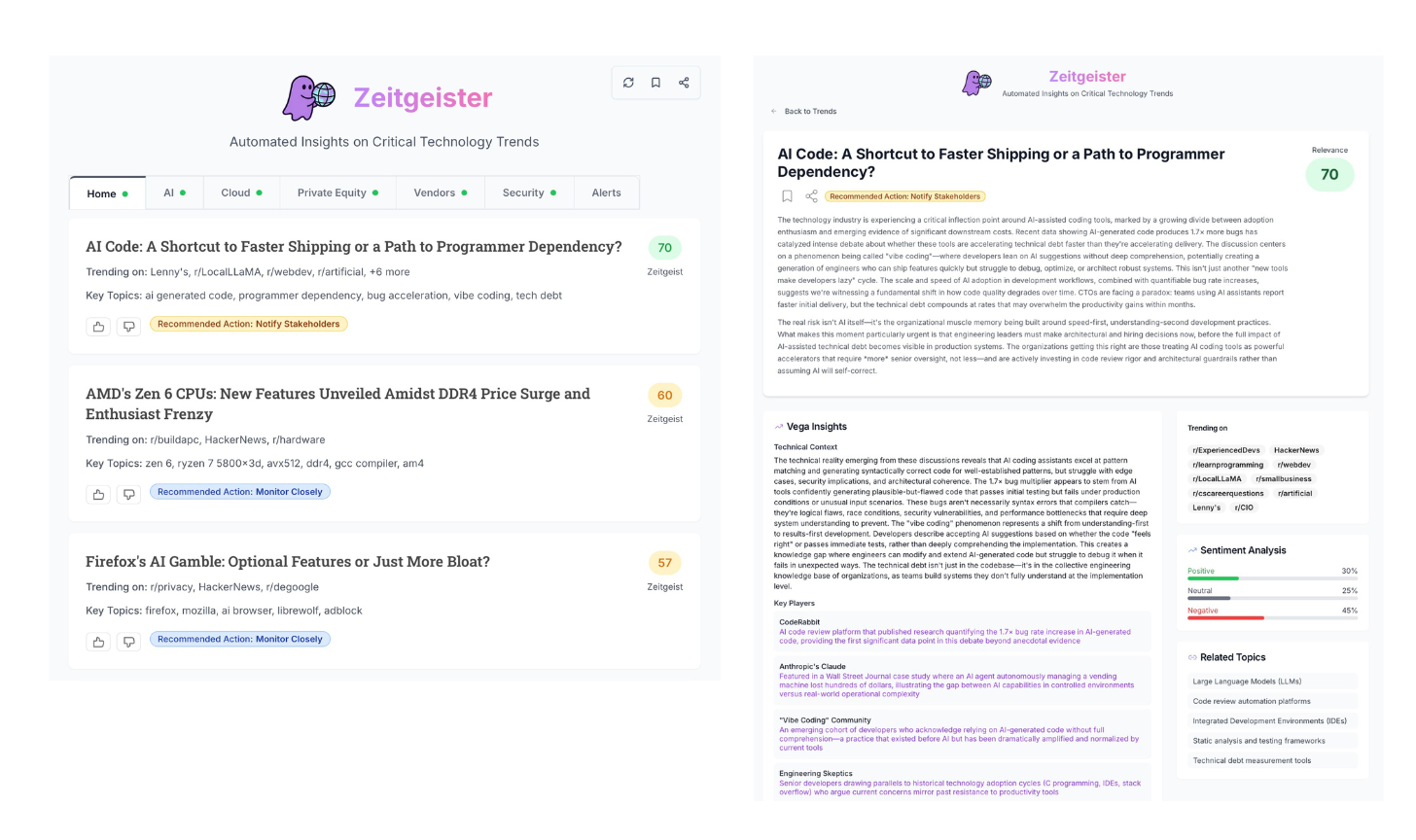
It’s free, and you’ll get:
🧠 Agnostic trend feed across Reddit, HN, news, and more
📊 Synthesized briefings with context, risks, and opportunities
🗣️ Stakeholder-ready talking points for CEOs, boards, and PE partners
⏱️ Saves me a couple of hours a week on “what’s going on and why do I care?”