

Weekly Zeitgeister: AI Security Concerns Get Real As Copilots Hijacked, Pipelines Exposed
Plus: Target’s code theft, ICE’s Palantir-powered AI dragnet, AWS CodeBuild’s near-miss, and more — Powered by Zeitgeister.


What is Weekly Zeitgeister?
Weekly Zeitgeister is a new series powered by Zeitgeister, a tool I built to track what’s actually moving in tech, rank top stories, and turn them into usable insight. Each week, I pull one high-signal headline per day from Zeitgeister, attach a brief summary, and then share why it matters if you’re building or running software at scale.
This Week at a Glance
Monday’s Headline: Target’s Source Code Heist: Hackers Hit the Bullseye, Leaving Security in Shambles
Tuesday’s Headline: Palantir’s ELITE Tool: ICE’s AI-Powered Dragnet Turns Neighborhoods Into Hunting Grounds
Wednesday’s Headline: AWS CodeBuild’s Regex Blunder: Two Missing Characters Nearly Handed Attackers the Keys to the Kingdom
Thursday’s Headline: SAP ECC to Azure Migration: Stop Overthinking It—Just Use Azure Data Factory Already
Friday’s Headline: Microsoft Copilot’s “Reprompt” Exploit: Phishing Meets Prompt Injection in a Security Trainwreck (Now Patched)
Monday – Target’s Source Code Heist: Hackers Hit the Bullseye, Leaving Security in Shambles
Sentiment Analysis: 5% Positive | 25% Neutral | 70% Negative
What happened
~900GB source code was allegedly stolen: Threat actors claim they pulled it from Target’s internal dev Git server; leaked samples were reportedly confirmed as authentic by employees.
Target moved fast to lock down Git access: An “accelerated” response now requires VPN, suggesting the dev environment may have been under-protected pre-incident.
This is more than standard IP theft - it’s a blueprint leak: Repos can reveal architecture decisions, auth patterns, API endpoints, third-party integrations, and sometimes embedded secrets, giving attackers time to map weak points
Why it matters
Security risk: Dev tooling often gets treated as “internal,” but it’s a high-value target—and source exposure makes downstream exploitation easier.
Cost + downtime: Expect access audits, credential/secrets rotation, repo scanning, and vulnerability assessment—plus ongoing monitoring.
Reputation + trust: It revives questions about whether security investments are changing behavior or just checking boxes—especially given Target’s breach history.
Actionable Insights
Treat dev infrastructure as production: Lock down Git and related tooling with SSO, MFA, least privilege, and full audit logging.
Assume secrets leaked: Scan repo history, rotate keys and tokens, and eliminate long-lived credentials in favor of managed secrets.
Harden CI/CD and automation: Review service accounts and token scopes, restrict network access, and monitor for unusual pulls, clones, and admin actions.
Boardroom Talking Point
“Development infrastructure is vulnerable now. If our repos or CI systems are softer than prod, a breach turns into a roadmap for future compromise. We should be upgrading dev security to the same tier as core infrastructure.”
Tuesday – Palantir’s ELITE Tool: ICE’s AI-Powered Dragnet Turns Neighborhoods Into Hunting Grounds
Sentiment Analysis: 5% Positive | 10% Neutral | 85% Negative
What happened
Palantir’s ELITE (Enhanced Leads Identification & Targeting for Enforcement) system is being used to scale ICE targeting - a shift from case-by-case enforcement to batch “population processing.”
The tool enables map-based sweeps: officers can draw boxes on a map to surface and batch-select people for action, using confidence scoring and aggregated records.
Data aggregation + workflow automation turns this into an end-to-end pipeline: identify → compile lists → supervisor approval → field ops - with obvious implications for any company building data products that can be repurposed for enforcement.
Why it matters
Risk: If your APIs/data products feed enforcement ecosystems, you can inherit ethical + regulatory exposure even without “direct” involvement.
Reputation: Association-by-integration becomes a default judgement. Partners, customers, and the public may treat your stack as part of a negative/controversial outcome.
Talent: Controversial end-use becomes an HR problem fast: retention, recruiting, and internal trust take the hit when teams feel the product is being used to harm people.
Leverage: This is a classic repurposing problem - capabilities built for one context can be redeployed at scale for malicious/controversial purposes.
Actionable Insights
Define hard boundaries: Publish and enforce acceptable-use rules with technical controls (not just policy text) for sensitive capabilities.
Design for repurposing risk: Assume high-impact features will be used in ways you didn’t intend; build limits, logging, and oversight hooks early.
Audit your exposure: Map where your data, APIs, or infra could plug into surveillance/enforcement workflows, directly or via partners.
Boardroom Talking Point
“We need a clear line on who we’ll support and who we won’t. ‘Just selling the tool’ doesn’t work when it drives real-world enforcement outcomes. The next step is to define written guardrails: approved use cases, prohibited use cases, and what we’ll do when a customer crosses the line.”
Wednesday – AWS CodeBuild’s Regex Blunder: Two Missing Characters Nearly Handed Attackers the Keys to the Kingdom
Sentiment Analysis: 15% Positive | 25% Neutral | 60% Negative
What happened
Wiz reported it found a flaw in AWS’s CodeBuild-based CI/CD trust gate: a contributor allowlist regex was missing start/end anchors (^ / $), so any ID that contained an approved number could pass.
An outsider could brute-force their way into “trusted” status: by mass-creating GitHub accounts until one matched the loose pattern, then opening a PR to trigger privileged workflows.
If the workflow ran, the stakes escalated fast: attackers could access repo-scoped GitHub tokens and use that foothold to move toward repo takeover. AWS patched in September 2024 after responsible disclosure in August, and reported no customer impact.
Why it matters
Supply chain risk: compromising a core repo like the AWS JavaScript SDK could quietly flow into downstream products before anyone notices.
Trust gates are fragile: one tiny config mistake can undo your “trusted contributor” controls—and it often slips past normal review.
Token mistakes compound incidents: long-lived credentials turn a short gap into a long cleanup, forcing broad rotations and audits.
Vendor confidence: even a near miss pushes teams to re-check CI/CD governance, logging, and disclosure timelines.
Actionable Insights
Audit all matching logic: review allowlists, regex checks, and identity gates for exact matching, explicit anchors, and clear trust rules.
Require approval for untrusted triggers: add explicit review/approval for workflows initiated by external contributors or unknown code paths.
Shorten credential lifetimes: move to short-lived, least-privileged tokens, rotate aggressively, and alert on unusual workflow runs, token usage, or collaborator/admin changes.
Boardroom Talking Point
“CI/CD is a privileged system. If the guardrails are loose, a pull request can become an access key.”
Thursday – SAP ECC to Azure Migration: Stop Overthinking It—Just Use Azure Data Factory Already
Sentiment Analysis: 60% Positive | 30% Neutral | 10% Negative
What happened
SAP ECC teams are moving data to Azure now: Orgs are pulling data out of legacy SAP ECC into Azure for analytics and reporting, often using Self-Hosted Integration Runtime as the secure bridge.
Azure Data Factory is becoming the default integration layer: The emerging guidance is to use ADF’s SAP connectors and established patterns instead of building bespoke pipelines from scratch.
The 2027 deadline is driving “bridge” builds: With SAP ECC mainstream maintenance ending in 2027, teams are setting up interim Azure integrations while the bigger S/4HANA path gets decided
Why it matters
Cost + complexity: Every custom integration adds ongoing maintenance and later rework, especially once S/4HANA enters the picture.
Security + compliance: SHIR and integration jobs become high-value connective tissue into SAP data and need hardening, monitoring, and tight change control.
Leverage: Getting SAP data flowing reliably into Azure unlocks faster reporting and AI use cases without having to replace ERP first.
Actionable Insights
Standardize the approach: Inventory all SAP-to-Azure pipelines and consolidate around ADF connectors and reference architectures where possible.
Operationalize SHIR: Define a baseline for access, patching, logging, and ownership so it’s managed like critical infrastructure, not a side project.
Set a decision calendar: Publish a modernization roadmap that names the bridge period and the date you commit to the S/4HANA direction, so the bridge doesn’t become permanent.
Boardroom Talking Point
“SAP ECC support ends in 2027; we should fund a secure Azure data bridge now and lock a timeline for the S/4HANA decision so we don’t get forced into a rushed, higher-risk migration later.”
Friday – Microsoft Copilot’s “Reprompt” Exploit: Phishing Meets Prompt Injection in a Security Trainwreck (Now Patched)
Sentiment Analysis: 10% Positive | 30% Neutral | 60% Negative
What happened
A “Reprompt” exploit showed how Copilot sessions could be hijacked via phishing: attackers used seemingly legit links to get users to click, then injected malicious instructions into the active Copilot session.
The trick leveraged URL parameters to smuggle prompts past protections: the injected prompt effectively “speaks as the user,” pushing Copilot to reveal or export sensitive info.
Microsoft patched the specific issue, but the bigger takeaway remained: assistants that ingest external content (links, emails, docs) are a standing prompt-injection surface, not a one-off bug.
Why it matters
Real data exposure risk: if Copilot can access mail, files, or internal systems, prompt injection becomes an exfiltration path — and phishing is still the easiest delivery mechanism.
“Patched” doesn’t mean “solved”: variants of the same pattern will keep appearing because the core problem is boundary-setting between untrusted inputs and privileged actions.
Governance gets harder as capability expands: every new Copilot integration (more connectors, more permissions) widens the blast radius and increases the burden on security teams.
Actionable Insights
Treat Copilot like a privileged system: inventory what it can access, reduce permissions to least-necessary, and separate sensitive repositories from assistant reach by default.
Add AI-specific guardrails, not just vendor updates: implement DLP rules for AI interactions, monitor unusual access/export patterns, and require stronger controls for actions that move data out.
Update phishing training for “AI-shaped” attacks: teach employees that a normal-looking link can now manipulate an assistant session — and build a clear incident workflow when they suspect it happened.
Boardroom Talking Point
“Copilot is a new data access layer, so we need to limit its permissions, monitor AI-driven data access, and plan for prompt-injection variants even after patches ship.”
There you have it: five days, five headlines - each with a breakdown of what happened, why it matters for tech leaders, what to do next, and what to say to show stakeholders you’re aware and prepared for the future.
Back with another Weekly Zeitgeister next week.
Enjoy your weekend!
If you’d rather see trends personalized to you - mapped, explained, and ranked to your domains, your vendors, and your board conversations - try Zeitgeister.
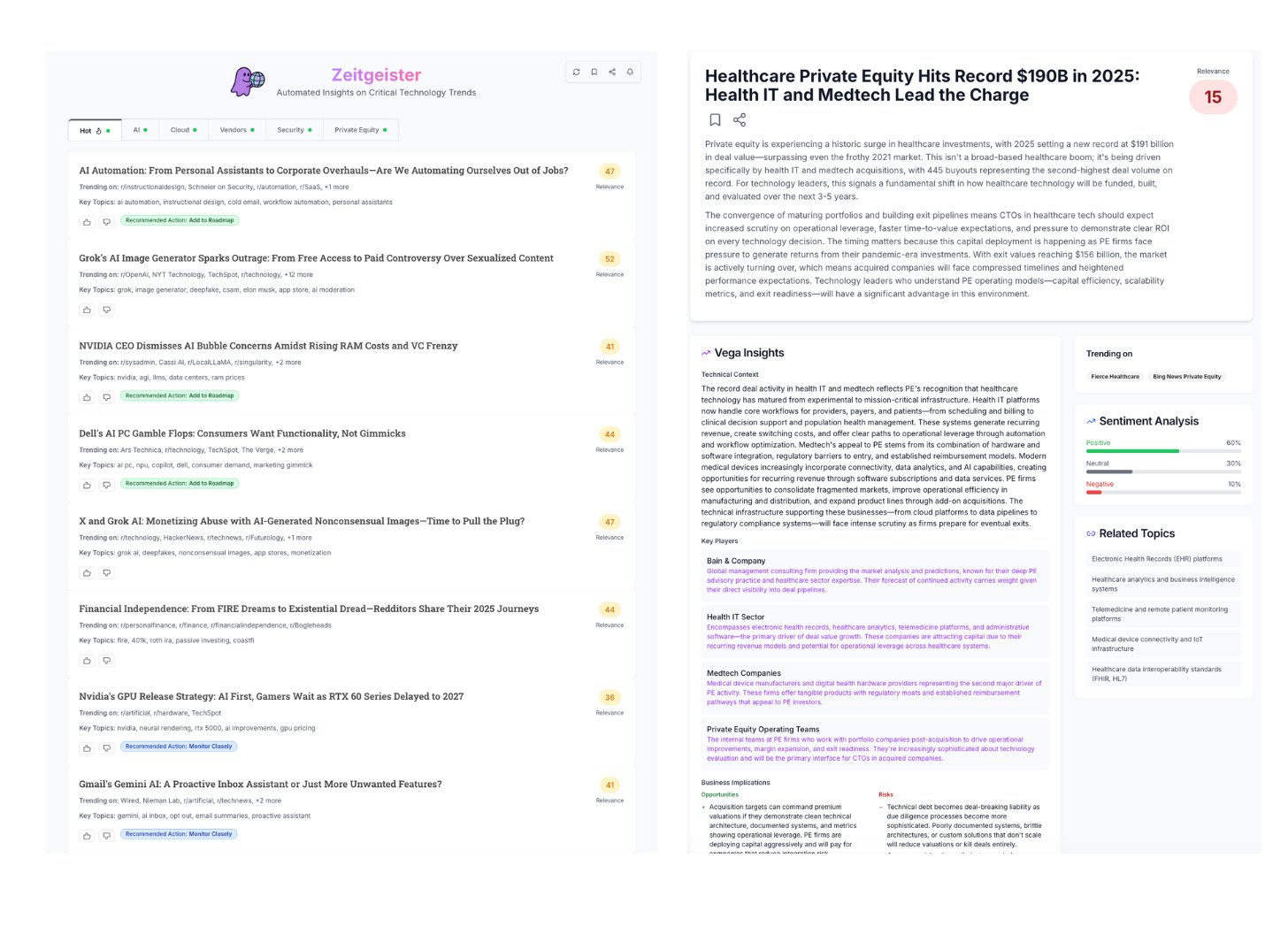
It’s free, and you’ll get:
🧠 Agnostic trend feed across Reddit, HN, news, and more
📊 Synthesized briefings with context, risks, and opportunities
🗣️ Stakeholder-ready talking points for CEOs, boards, and PE partners
⏱️ Saves me a couple of hours a week on “what’s going on and why do I care?”
Another good weekly snapshot.
Monday's news on Target git dev beach should be a wake up call for enterprises who are still not having source code behind VPNs along with other protection mechanisms like properly managed secrets.
Even for best protected enterprises, yesterday's protections might not hold good for today's and tomorrow's world with AI coding tool proliferation. Most of these tools are SAAS with full code access which makes a theft much more probable, sometimes thru breach or sometimes intentionally by these AI tools itself in the guise of learning context.