

Why AI Isn't Working At Your Company
It’s not the tech. AI is just holding a magnifying glass to everything you’d rather not look at.

There are so many great companies having a really hard time getting business results from AI. And the CEOs at these organizations are totally perplexed about why.
If you’re in one of these businesses, the frustration can be high. But fortunately, both the diagnosis and the fix are straightforward.
Keep in mind, starting about two years ago AI was thought to be the ultimate form of automation — an intelligent technology that could actually understand what was going on inside convoluted business processes in the enterprise, and then take that knowledge and execute 100 times faster than humans.
So it’s no wonder every CEO thought this combination of intelligence & speed would be the winning formula for their company — after all, it all sounds very intuitive.
But, nope. A couple of years into the AI era, most organizations — even normally great ones — haven’t seen the business needle move all that much.
In fact, MIT’s now famous NANDA study found that 95% of enterprise GenAI pilots have delivered zero measurable P&L impact. So we’re 30 to 40 billion dollars in, and almost nothing to show for it.
Are you wondering why?
Well, there are basically 2 reasons for it, from what I’ve observed:
Shockingly, most companies don’t actually know what makes them successful
Even when they do, their underlying business process is usually really bad.
So all these great companies are sitting around thinking they know where to apply AI, but they’re actually pretty clueless about it.
Here’s a simple example:
A company brings AI into their sales organization, but after 18 months there’s no increase in revenue. This company never understood that what made their sales organization great was actually their VP of Sales, Elizabeth, and her mojo at both selling big deals and hiring great salespeople. So the company wasted 18 months on AI tools to generate more leads and do some sentiment analysis — when instead they should’ve been studying Elizabeth, using AI to analyze her winning sales calls and training the junior staff.
Do you see how easy it is for companies to completely miss what makes them win?
They very often lack clarity on the people, culture, decisions, and capabilities that actually drive results. And they expect AI to somehow deliver measurable outcomes.
AI cannot manufacture organizational clarity.
To every CEO investing in AI: you have to be right about the levers that make your business successful. And it’s different for every company. There is no one-size-fits-all. (The SVPG crew capture a version of this in The AI Productivity Paradox — thanks to AI, it’s never been easier to build the wrong thing, faster.)
The second problem is that the underlying business process is usually a complete mess.
Take a look under the hood at any great organization that’s scaling and you’ll find repeatable, efficient processes. But average or poor companies have messy, super-organic processes that sometimes work and sometimes don’t.
When these organizations apply AI, it triggers a collapse — because the teams are confronted, perhaps for the first time, with the reality that they don’t have a repeatable formula for succeeding.
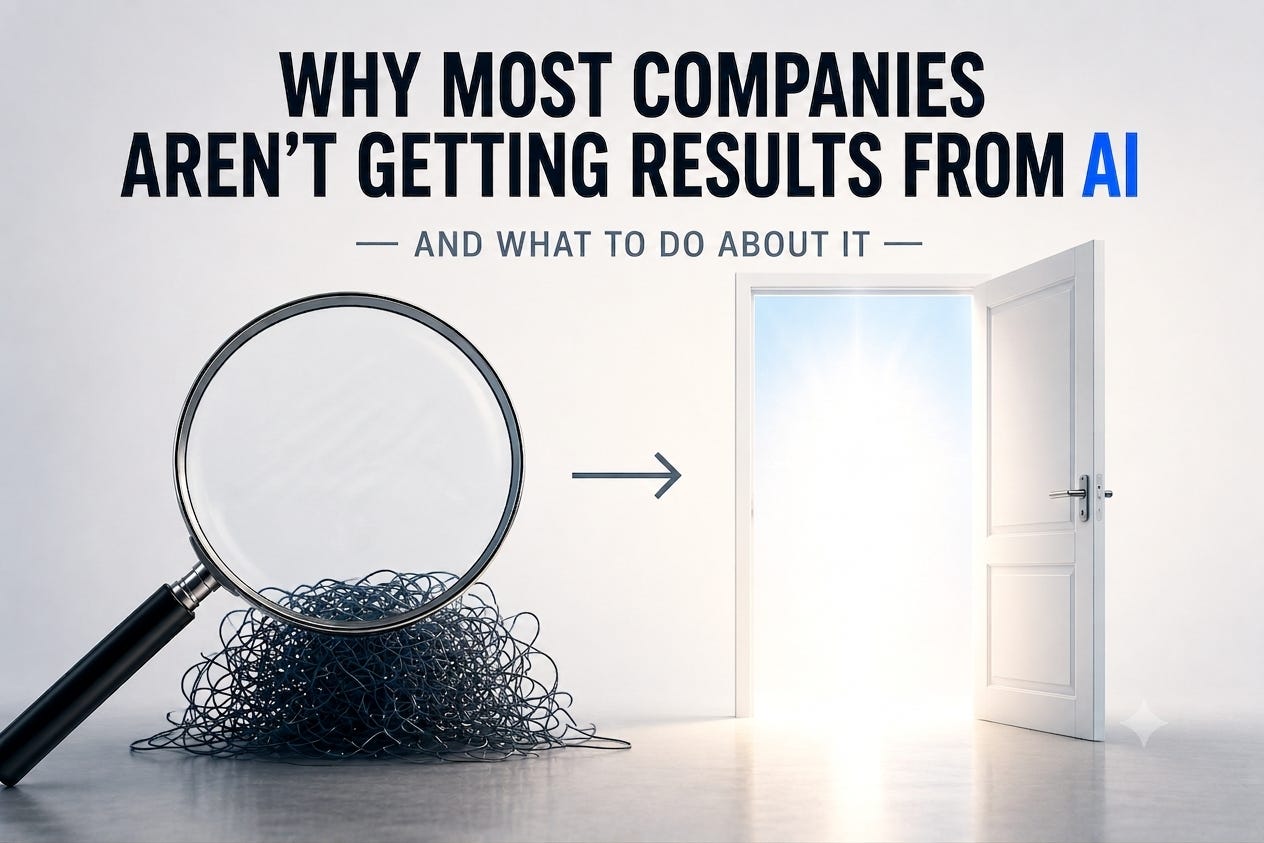
For these organizations, AI is nothing more than an embarrassing magnifying glass on their faulty processes.
Companies could dramatically increase their ROI on AI by first understanding what truly makes them successful. What sets them apart? What capabilities, decisions, and processes drive their performance? And what will create their next wave of growth? Once they have that clarity, they can apply AI to the areas that matter most.
Companies must also improve their business processes in parallel with adopting AI. They cannot freeze inefficient processes in place and simply layer AI on top — the processes themselves must evolve as AI is introduced. (This is the single biggest differentiator in McKinsey’s State of AI research: the high performers are nearly 3x more likely to have fundamentally redesigned their workflows, not just bolted AI onto the old ones.)
Organizations that master both of these concepts are reaching levels of performance that would have seemed impossible just a few years ago.
Reach out if you need anything. And in the meantime, keep the shark swimming! 🦈