

Weekly Zeitgeister: Imagination Becomes Reality As Hyundai Goes Humanoid
Plus: FortiGate firewalls fail, Terraform's verification gap creates chaos, Tailwind hit with AI reality check, and more — Powered by Zeitgeister.


What is Weekly Zeitgeister?
Weekly Zeitgeister is a new series powered by Zeitgeister, a tool I built to track what’s actually moving in tech, rank top stories, and turn them into usable insight. Each week, I pull one high-signal headline per day from Zeitgeister, attach a brief summary, and then share why it matters if you’re building or running software at scale.
This Week at a Glance
Monday’s Headline: Fortinet’s FortiGate Firewalls: Patched Devices Still Getting Pwned—Time to Put a Firewall in Front of Your Firewall?
Tuesday’s Headline: MIT’s Recursive Framework Cracks the 10M Token Barrier—Finally, LLMs That Don’t Forget What They Just Read
Wednesday’s Headline: Terraform at Scale: When Your “Infrastructure as Code” Becomes “Infrastructure as Chaos”
Thursday’s Headline: Tailwind’s AI Reality Check: 75% of Engineering Team Laid Off as AI Disrupts Business Model
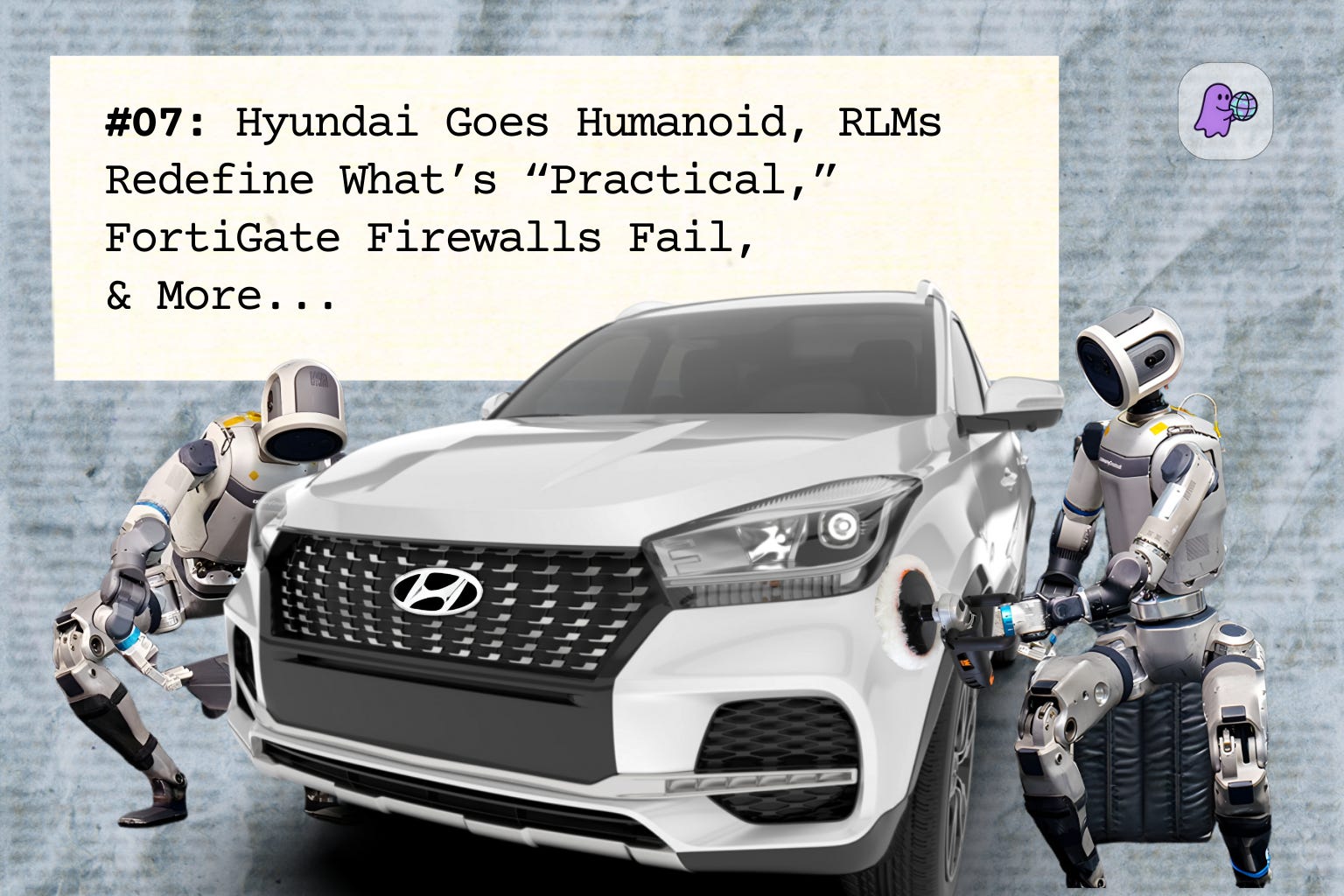
Friday’s Headline: Hyundai’s Atlas Robots: From CES Showpiece to Factory Workhorse by 2028
Monday – Fortinet’s FortiGate Firewalls: Patched Devices Still Getting Pwned—Time to Put a Firewall in Front of Your Firewall?
Sentiment Analysis: 5% Positive | 20% Neutral | 75% Negative
What happened
FortiGate firewalls were hit by an active automated attack campaign: Attackers targeted a critical authentication bypass (CVE-2025-59718) and were observed running a new wave of automated attacks since mid-January 2026.
“Fully patched” devices were still getting compromised: Researchers observed successful breaches on devices running the latest firmware, indicating an incomplete patch or additional unpatched vulnerabilities.
Attackers followed a consistent playbook after getting in: They bypassed FortiCloud SSO, created persistent admin/backdoor accounts, enabled unauthorized VPN access, and stole complete firewall configuration files (topology, rules, VPN credentials, security policies).
Why it matters
Risk (quiet compromise with delayed exploitation): Attackers silently establish persistence, then return later for full configuration theft—organizations may be breached without knowing it.
Security (trust breaks): If “patched” doesn’t mean safe, your perimeter control can’t be treated as dependable.
Regulatory & reputational exposure: When the security tool meant to protect your systems is itself compromised, the fallout is amplified—especially in regulated environments.
Actionable Insights
Lock down FortiGate management access immediately: Confirm management interfaces aren’t reachable from the internet, tighten access paths, review admin accounts added from Dec 2025 onward.
Treat firewall configs as stolen until proven otherwise: Assume attackers may have your network blueprint and VPN credentials; rotate VPN creds and re-check segmentation decisions with that assumption.
Add compensating detection now: Monitor for new admin accounts, configuration exports/changes, and VPN enablement on FortiGate devices.
Boardroom Talking Point
“FortiGate firewalls have been compromised even when patched—we’re treating this as a perimeter trust failure. We’re locking down management access, assuming configuration exposure, and immediately implementing monitoring and credential rotation while we assess vendor reliability and next steps.”
Tuesday – MIT’s Recursive Framework Cracks the 10M Token Barrier—Finally, LLMs That Don’t Forget What They Just Read
Sentiment Analysis: 70% Positive | 25% Neutral | 5% Negative
What happened
MIT CSAIL introduced Recursive Language Models (RLMs): a way to run LLMs that lets them work through huge prompts step-by-step instead of trying to hold everything in one giant window.
It tackles “context overload” without bigger context windows: the model revisits snippets, processes them in manageable pieces, then combines the results.
The headline claim is “10M+ tokens, now”: it’s framed as an orchestration layer around existing frontier models—no model retraining or architecture changes required.
Why it matters
Speed (new level of efficiency feasible): Full codebase analysis, multi-document review, heavyweight research synthesis move from “blocked” to feasible.
Cost (stop brute-forcing everything): If the system can decide what to read, re-check, and ignore, you burn fewer cycles pushing massive text through expensive inference.
Strategy (edge shifts to orchestration): As models commoditize, differentiation moves to the orchestration layer—how you break down tasks, route them, and synthesize results.
Competitive timing (6-12 month window): Early adopters can differentiate by handling tasks that competitors can't before recursive techniques become standardized.
Actionable Insights
Dig up some projects in your “token limit graveyard”: Consider projects on hold because inputs were too large (codebases, compliance, contracts, research) - re-rank and execute.
Run one tight pilot: Choose a single high-value workflow and test recursive decomposition on real internal data — see what reliability and effort look like in practice.
Don’t overlook the tradeoffs: RLMs trade latency for context capacity— test whether your use cases can tolerate the additional processing time.
Reset focus: Train toward orchestration (breaking work into steps, stitching results) and push vendors on support/timelines for recursive-style workflows.
Boardroom Talking Point
“MIT solved the context problem through orchestration, not bigger models—our existing AI investments can now handle 10M+ tokens through smarter infrastructure. We have a 6-12 month window to deploy this on high-value use cases before it becomes table stakes.”
Wednesday – Terraform at Scale: When Your “Infrastructure as Code” Becomes “Infrastructure as Chaos”
Sentiment Analysis: 35% Positive | 25% Neutral | 40% Negative
What happened
Plan review and execution didn’t align: Teams generated a Terraform plan during PR review but by the time it ran, infrastructure had shifted. The applied result didn’t match what reviewers approved.
A “verification gap” caused approvals on stale intel: Manual console changes, concurrent deployments, and time delays meant people approved plans that were outdated when applied.
Changes treated as suggestions, not contracts: Without storing/verifying the exact plan, pipelines let the live environment reshape deployments—creating major discrepancies between intended and actual changes.
Why it matters
Risk (state drift causes blind changes): When infrastructure drifts from the reviewed plan, approved changes can have completely different—sometimes dangerous—outcomes.
Security (audit + exposure): Unsigned plans and auto-approve pipelines create accountability gaps, making it easier for bad changes to slip through without verification.
People (scale): When teams can’t trust approved changes will deploy as reviewed, they either slow down with excessive verification or speed up blindly—both make scaling harder.
Actionable Insights
Audit the plan → apply gap: Verify whether your pipeline deploys the exact plan from PR review, or regenerates a new plan at apply time.
Require proof of approved deployment: Store the PR plan artifact and compare byte-for-byte at release; block if it doesn’t match.
Add pre-deployment enforcement: Use policy-as-code (e.g., OPA) to validate plans before approval, and control-plane policy (e.g., Azure Policy) to prevent non-compliant deployments.
Boardroom Talking Point
“We’ve identified a control failure: people can approve one infrastructure change and a different one can go live. We’re closing the verification gap by requiring deployments to prove they’re applying the exact approved plan, with policy enforcement to prevent unsafe changes.”
Thursday – Tailwind’s AI Reality Check: 75% of Engineering Team Laid Off as AI Disrupts Business Model
Sentiment Analysis: 33% Positive | 34% Neutral | 33% Negative
What happened
Tailwind cut 75% of its engineering team: Not because Tailwind usage fell — the founder said usage is at all-time highs — but because the business model got hit.
The discovery funnel broke: Documentation traffic dropped ~40% since early 2023, and revenue from Tailwind’s paid products (UI components/templates) fell ~80%.
AI became the middleman: Developers increasingly ask Copilot/ChatGPT/ Claude to generate Tailwind code and components on demand, instead of reading docs or buying pre-built UI kits.
Why it matters
“Adoption” can lie: A tool can be everywhere and still lose its ability to monetize — usage grows while revenue collapses.
Docs as growth engine just got weaker: If your customers arrive through documentation/tutorials, AI can short-circuit that path.
Open-source sustainability risk: When the commercial layer gets squeezed, the project still has to be maintained — but the funding source dries up.
Actionable Insights
Audit your doc → revenue path: If your product relies on documentation-driven discovery, measure how much AI is siphoning that traffic and where conversions are failing.
Stop selling “stuff,” start selling outcomes: AI can replicate components/templates; it can’t easily replace performance hardening, security, compliance certification, or deep integrations.
Watch for the “hollow growth” trap: If usage grows while revenue or monetization engagement declines, AI may be intermediating your customer relationships—recalibrate your success metrics accordingly.
Build for an AI-first workflow: Assume AI-generated code is the starting point — then sell the layers that make it production-safe (validation, governance, remediation, support).
Boardroom Talking Point
“Tailwind is a warning signal: AI can boost adoption while breaking monetization. The next move we should make is mapping where AI is intercepting customer discovery and shifting our paid value toward outcomes and enterprise-grade support that AI can’t reliably replace.”
Friday – Hyundai’s Atlas Robots: From CES Showpiece to Factory Workhorse by 2028
Sentiment Analysis: 55% Positive | 25% Neutral | 20% Negative
What happened
Hyundai put a real deployment date on humanoids: It announced plans to deploy Boston Dynamics’ Atlas robots at its Georgia EV manufacturing facility by 2028, scaling to thousands of units a year.
This moved beyond demo theater: Hyundai is already building the manufacturing version of Atlas—humanoid robotics shifting from R&D spectacle to production reality.
Atlas is being treated like a tool, not a “human replica”: The framing was “bipedal forklifts” built for human-designed factories (doorframes, existing layouts), paired with multi-modal AI so robots can take visual + text instructions.
Why it matters
Manufacturing advantage is now a near-term race: The window is closing—late movers could be 3–4 years behind teams already iterating toward 2028–2030 deployments.
Adoption may be easier than people assume: If robots fit existing facilities, you can modernize without rebuilding the whole plant.
Two new headaches show up fast: specialized AI chips could bottleneck scaling, and workforce displacement without a transition plan becomes a real operational/regulatory risk.
Actionable Insights
Do a facility + task audit: Identify where humanoids could slot into today’s workflows (manufacturing or logistics) without major retrofits—assess compatibility first.
Start vendor conversations now: Lead times and deployment requirements imply a 3–4 year planning horizon is becoming normal for serious robotics integration.
Plan for chips + people early: Pressure-test semiconductor supply relationships and build a workforce transition plan for repetitive physical roles before automation accelerates.
Boardroom Talking Point
“Hyundai just made humanoid robots a 2028 factory plan. We’re identifying where they’d fit in our operations, lining up suppliers (especially chips), and putting a workforce transition strategy in place before this becomes a scramble.”
There you have it: five days, five headlines - each with a breakdown of what happened, why it matters for tech leaders, what to do next, and what to say to show stakeholders you’re aware and prepared for the future.
Back with another Weekly Zeitgeister next week.
Enjoy your weekend!
Bobby
P.S. If you’d rather see trends personalized to you - mapped, explained, and ranked to your domains, your vendors, and your board conversations - do give Zeitgeister a try.
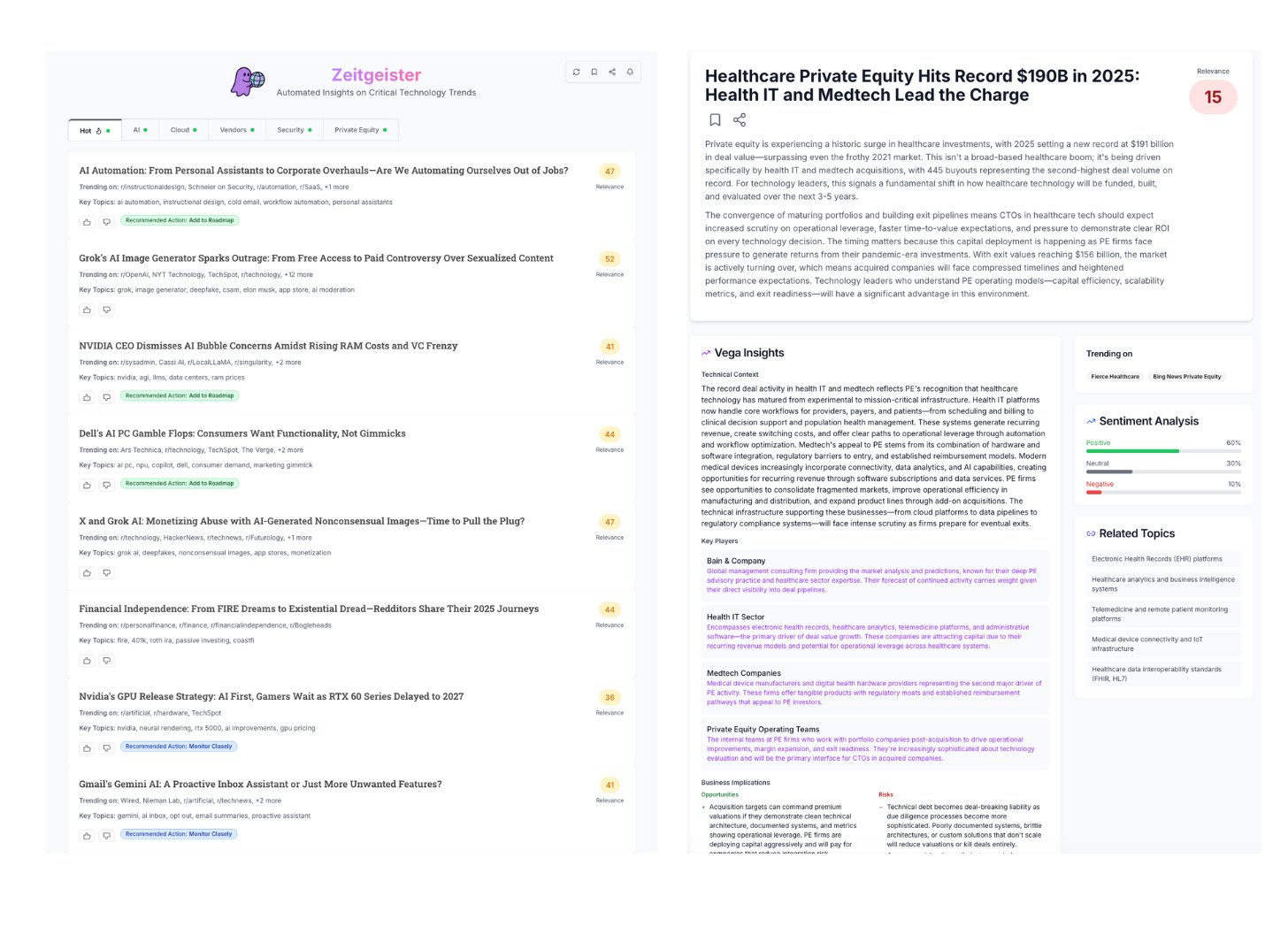
It’s free, and you’ll get:
🧠 Agnostic trend feed across Reddit, HN, news, and more
📊 Synthesized briefings with context, risks, and opportunities
🗣️ Stakeholder-ready talking points for CEOs, boards, and PE partners
⏱️ Saves me a couple of hours a week on “what’s going on and why do I care?”
Hey, great read as always. Maybe my pilates instructor will be a robot soon, ha.
I personally feel many doc driven AI tools for enterprises will not survive unless they pivot as stated. Orgs like mine are already leveraging built in enterprise AI wrapped around gpt like products using power automate to leverage enterprise knowledge, be it production incident tickets, confluence or product documentation.